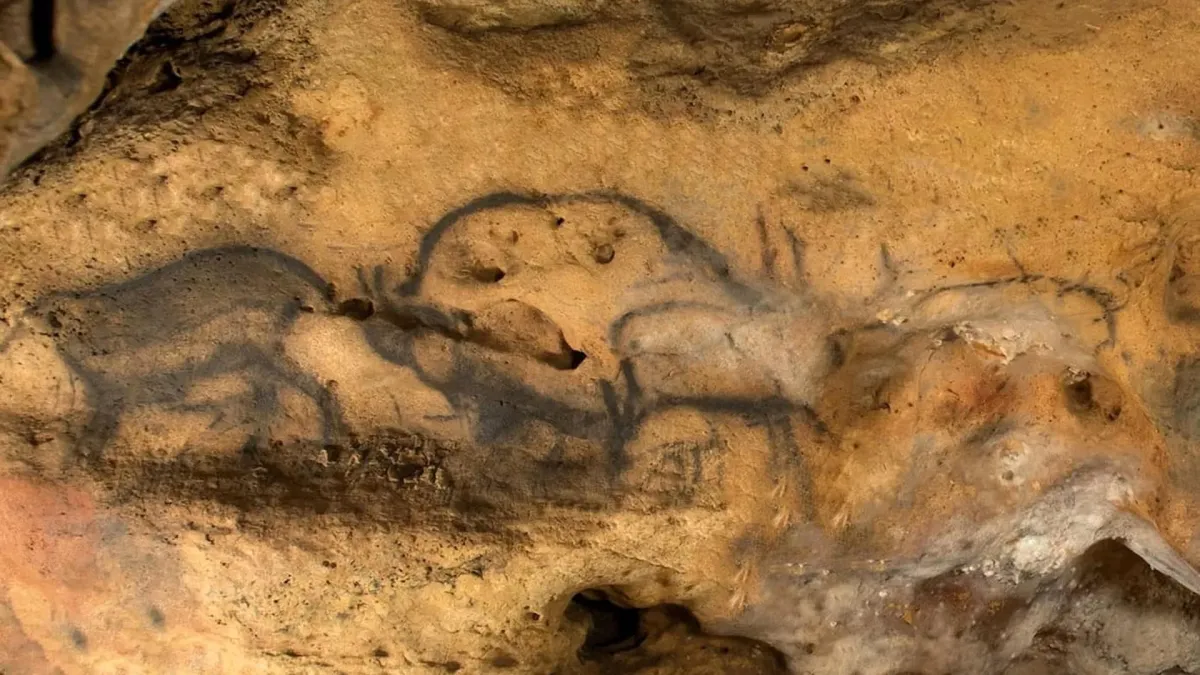
Scientists have finally put an accurate age on prehistoric paintings in France's Font-de-Gaume cave, thanks to tiny traces of hidden charcoal. This breakthrough provides solid dates for a bison and a masklike figure, revealing that parts of the artwork were created centuries, even millennia, apart, potentially revolutionizing how we understand when ancient humans created and revisited these sacred spaces.
For ages, dating ancient cave art has been a major headache. While charcoal is perfect for radiocarbon dating – a method that tracks the decay of radioactive carbon – many black pigments were thought to be made from minerals like iron and manganese oxides, which lack carbon. This made direct dating impossible, leaving researchers guessing about the timelines of these masterpieces.
The research team employed advanced techniques like Raman microspectrometry and hyperspectral imaging to scrutinize the pigments in two black figures at Font-de-Gaume. These methods, which can identify materials without harming the art, uncovered consistent traces of charcoal mixed within the black pigment. Crucially, the uniform distribution suggested the charcoal was part of the original artwork, not later contamination.
With special permission, minuscule samples of the charcoal-infused pigment were taken for carbon-14 dating. The results were game-changing. The bison painting was dated to between 13,461 and 13,162 years ago (calBP), fitting within the Upper Paleolithic period. However, the mask figure yielded a much more complex story, with different sections dating to vastly different periods: 8,993-8,590 calBP, 15,981-15,121 calBP, and 15,297-14,246 calBP.
This suggests the mask wasn't a single creation but rather a site of artistic activity across thousands of years. It implies that decorated caves weren't just static galleries, but possibly meaningful places that communities revisited, altered, and reinterpreted over vast stretches of time. This new method, combining chemical imaging with precise radiocarbon dating, could be applied to countless other previously undatable artworks, offering a richer picture of prehistoric cultures and the enduring significance of these ancient underground sanctuaries.