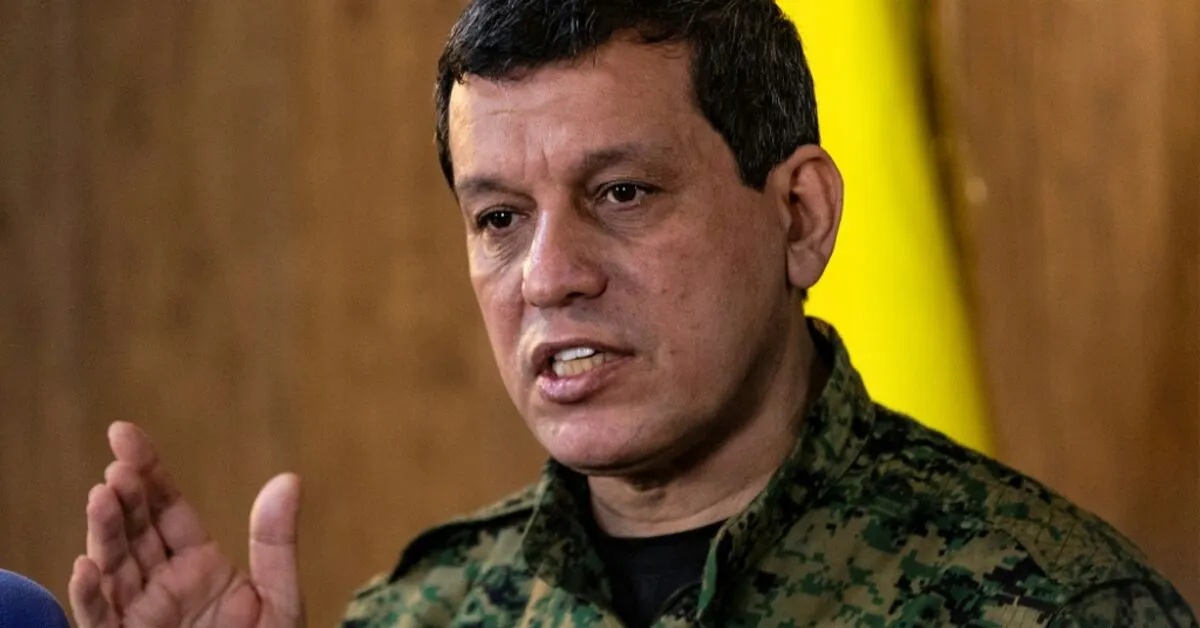
Syrian Kurdish leader Mazloum Abdi announced on Thursday that the integration of Kurdish civil and military institutions into Syria's state apparatus is now complete, signifying the conclusion of the Kurds' long-standing aspiration for autonomy.
The declaration follows months of negotiations between Kurdish representatives and Damascus, stemming from a January agreement that mandated the full incorporation of Kurdish administrative and security bodies into national structures. Abdi, who leads the Syrian Democratic Forces (SDF), stated at an event in Qamishli, northeastern Syria, that "the phase of integrating military, security and administrative institutions into national state institutions is complete and finished." He added, "From now on, we begin a new phase. Our struggle will continue, to cement our people's rights in the constitution."
The January accord, signed by Abdi and Syrian President Ahmed al-Sharaa, was reached after clashes between Kurdish fighters and forces loyal to the new Syrian administration, which resulted in the Kurds relinquishing significant territory in the north and northeast of the country. Amidst this conflict, President al-Sharaa signed a decree on January 16, which codified the national rights of Kurds and recognized Kurdish as a national language, a historic measure since Syria's independence in 1946.
Implementation of the deal has seen the Syrian government regain control of key areas, including the cities of Hasakeh and Qamishli, and the management of Qamishli airport and vital oil fields. The United States also transferred over 5,700 detainees from the Islamic State group, held in previously Kurdish-controlled camps, to neighboring Iraq. The SDF, a primary partner of the U.S. in the fight against ISIS, has seen its role diminish following shifts in American support.
The integration effectively dissolves the SDF, a force formed in 2015 with U.S. backing, which grew to approximately 100,000 fighters comprising Kurds and Arabs. However, a significant number of Arab fighters reportedly defected following the Syrian army's recapture of Raqa and Deir Ezzor provinces. This integration marks an end to the Kurdish dream of self-governance, despite the new administration granting them more rights than previous regimes, under which Kurds faced repression, including restrictions on teaching their language and practicing their culture.
"Dissolving the SDF means a bitter end," commented Mutlu Civiroglu, a Washington-based analyst and expert on Kurdish affairs. "A military force that has been very successful, that has defeated ISIS over and over, that has been admired by many, sadly comes to an end."