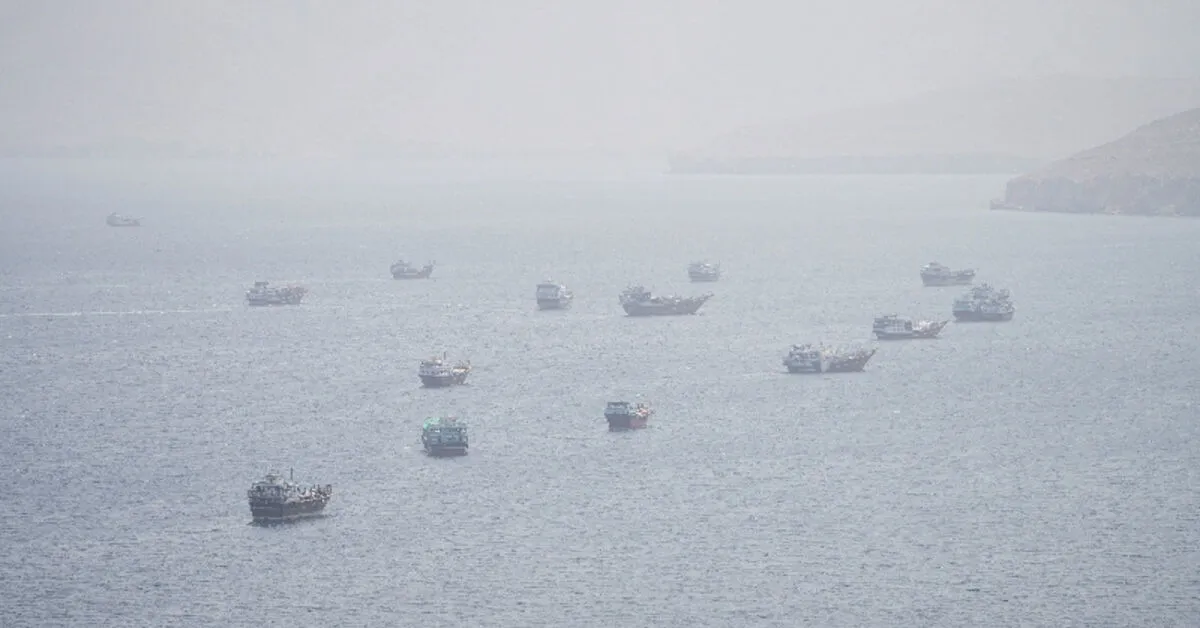
New reports of a ship being struck by a projectile in the Strait of Hormuz on Sunday have heightened concerns over Iran-related threats to global energy supplies, following a Saudi decision to close a crucial oil pipeline.
The UK Maritime Trade Operations (UKMTO), affiliated with the British navy, confirmed it had received a report of the incident. Details regarding the extent of damage to the vessel and the condition of its crew were not immediately available on Sunday morning.
This development occurred just one day after Saudi Arabia announced the temporary closure of its vital East-West pipeline. The precautionary measure was taken in response to a drone attack, which both Saudi and Iraqi authorities attributed to having originated in Iraq, an area where Iranian-backed militias are active.
The escalating conflict in the Middle East could lead to further increases in energy prices. This follows a week where Brent crude oil prices surpassed $100 per barrel. The East-West pipeline, spanning 1,200 km across the Arabian Peninsula, has been the primary conduit for Middle Eastern oil exports over the past six months, particularly as the Strait of Hormuz has faced significant disruptions due to the conflict.
The pipeline has been transporting between 4 million and 5 million barrels of oil per day, representing 4% to 5% of global supply. This route has shielded Saudi Arabia from the severe impacts experienced by other Gulf oil and gas producers. No group has yet claimed responsibility for the strikes on the pipeline. Satellite imagery depicted black smoke rising from a section of the pipeline south of Medina. The Saudi Foreign Ministry acknowledged some injuries and damage that were being assessed, without specifying the impact on export volumes.
U.S. President Donald Trump suggested that Iran was likely responsible for the attacks. Separately, Saudi Civil Defence reported on Saturday that a projectile fired by Houthi forces had injured two individuals and damaged several buildings, including a mosque, in the Jazan region.
Oil prices have surged recently, with diesel prices in the United States exceeding a record $6 per gallon. This surge is attributed to incidents involving tankers and the advance of Iran-aligned Houthis along the Red Sea, which threatens to disrupt another major oil route. The United States faces a strategic challenge in deciding whether to assist Saudi Arabia against the Houthis, a move that could escalate the conflict.
Crown Prince Mohammed bin Salman of Saudi Arabia reportedly requested U.S. military assistance in combating the Houthis during a phone call with President Trump on Thursday. Sources indicated that Washington conveyed it would not intervene directly at this time but would provide intelligence support. President Trump confirmed the conversation, noting that the Houthis had also contacted his administration to discourage direct U.S. involvement.
Yemeni government sources have reported that Houthi forces seized the strategic Perim Island on Friday, located at the entrance to the Red Sea in the Bab el-Mandeb strait. Discussions between the United States and Iran aimed at resolving the conflict have not occurred since a June agreement collapsed shortly after its inception.
Ebrahim Azizi, head of the Iranian parliament's national security committee, stated on Saturday that dialogue and negotiations would be unproductive unless the U.S. accepted all of Iran's conditions. Iran's Foreign Ministry announced on Friday that Iran would participate in a meeting with Gulf Arab states in Oman on Monday to discuss the future of the Strait of Hormuz. However, a senior Iranian official, speaking anonymously, downplayed expectations of a significant breakthrough, suggesting the meeting, initiated by Oman, was intended to cover various issues, including the strait, but was not anticipated to result in a signed agreement.