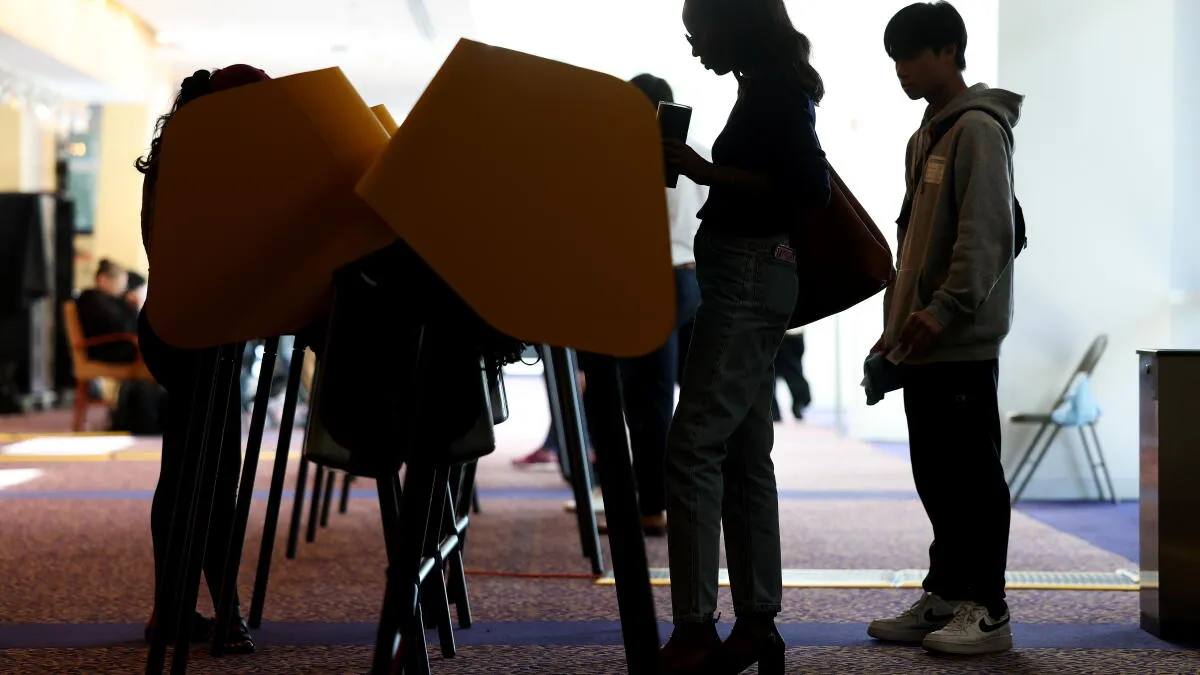
A recent study from UCLA's Latino Policy and Politics Institute reveals a notable gender-based divergence in political priorities among young and working-class Latinos in California, with young and working-class Latinas expressing a greater urgency to counter President Trump's agenda and protect immigrant communities compared to their male counterparts.
The findings underscore the complexity of the Latino electorate, which constitutes approximately one-third of California's eligible voters. G. Cristina Mora, a co-author of the study, emphasized that while the Latino population generally aligns with the Democratic Party, it is not a homogenous bloc. Analyzing the distinct policy views within subgroups is crucial, particularly given the significant disparity between eligible and actual Latino voters in the state.
Based on a May poll of 1,912 Latino registered voters in California conducted by UC Berkeley's Institute of Governmental Studies, Latinas under 30 demonstrated more progressive stances on immigration, voting rights, and opposition to Trump. Specifically, 82% of young Latinas cited fighting the Trump agenda as "very important," compared to 52% of young Latino men. Similarly, 88% of young Latinas prioritized protecting immigrant communities, versus 60% of young Latino men.
A similar trend was observed among working-class Latinos. Among those without a bachelor's degree, 73% of women considered the protection of immigrant communities a high priority, a figure that dropped to 51% for men, indicating a 22-percentage-point difference. However, this gender gap was less pronounced among older demographics and narrowed considerably among college-educated Latinos.
Political consultant Mike Madrid suggested that while gender is a correlating factor, generational and educational differences may exert a stronger influence on voting behavior. He noted that higher college attendance rates among young Latinas, a factor linked to more progressive views, could explain their leanings. Nonetheless, the study also indicated that even Latinas without college degrees held more progressive views than their male counterparts. Mora hypothesized that differing workplace environments—with many working-class Latinas in service-oriented roles like childcare or education, fostering community connections—could contribute to these left-leaning perspectives, contrasting with working-class Latino men potentially facing perceived economic competition in fields such as construction.
Mindy Romero, director of the Center for Inclusive Democracy, highlighted the study's reinforcement of the diverse viewpoints within the Latino voting population, suggesting opportunities for both major political parties to engage these voters. Both Madrid and Romero pointed out that Latino voters are not rigidly partisan and that issues beyond immigration, such as the cost of living, are paramount. Madrid predicted a significant political realignment among Latinos, driven by a lack of confidence in either party's ability to deliver tangible improvements to their lives.