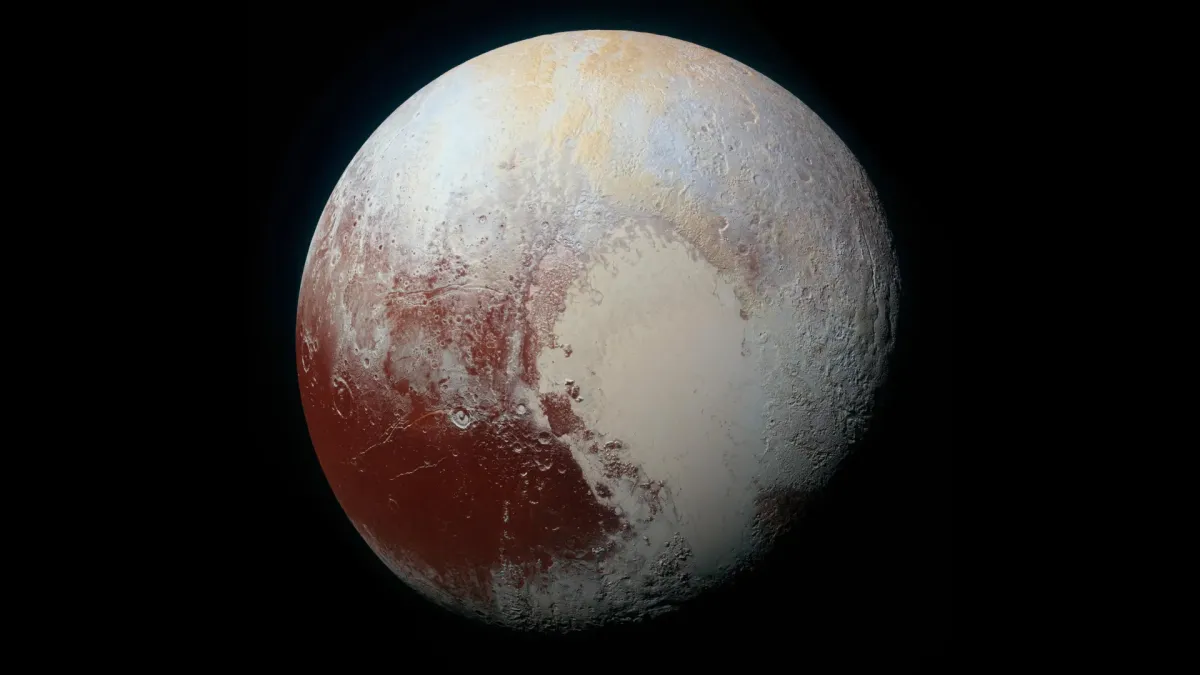
New research suggests liquid nitrogen might be actively flowing on Pluto's surface, breaking previous assumptions about the dwarf planet. Scientists analyzing data from NASA's New Horizons mission found evidence pointing to liquid nitrogen surfacing near the northern edge of Sputnik Planitia, the massive heart-shaped glacier.
This discovery, led by Dr. Alan Stern of the Southwest Research Institute (SwRI), marks the first indication of recent liquid activity on Pluto. "Pluto never stops surprising us," Stern remarked, highlighting that this finding points to a new type of dynamic feature on the dwarf planet.
Sputnik Planitia, larger than Texas and Oklahoma combined, is primarily composed of frozen nitrogen. Images from the New Horizons mission revealed unusual convection cells and dark patches in its northern region. Researchers now propose these features could be temporarily "wet" by liquid nitrogen rising from beneath the surface, as Pluto's frigid temperatures don't allow for rain.
The team drew parallels between these dark markings on Pluto and similar features on Earth's glaciers, like Greenland's ice sheet, where liquid water creates dark streaks. By comparing high-resolution images of Pluto with those of Earth's icy terrains, the researchers theorize that subsurface liquid nitrogen is wetting Sputnik Planitia's frozen surface. "The surface of Sputnik Planitia is quite young, probably less than one million years," stated SwRI Principal Scientist Dr. Kelsi Singer, a co-author of the study. "These features must have formed since then."
Computer simulations developed by Dr. Orkan Umurhan at the SETI Institute offer a potential mechanism: nitrogen ice deep within Sputnik Planitia could melt, forming liquid nitrogen that then travels upward through channels, similar to lava or geyser tubes, and emerges at the surface. This liquid could flow and create the observed dark patterns.
While this phenomenon hasn't been confirmed elsewhere on Pluto, large parts of the dwarf planet remain unmapped. The findings could also shed light on similar geological processes on other celestial bodies, such as Neptune's moon Triton, which exhibits geyser-like activity. Further observations are crucial to understanding if such liquid flows are common across the outer solar system.