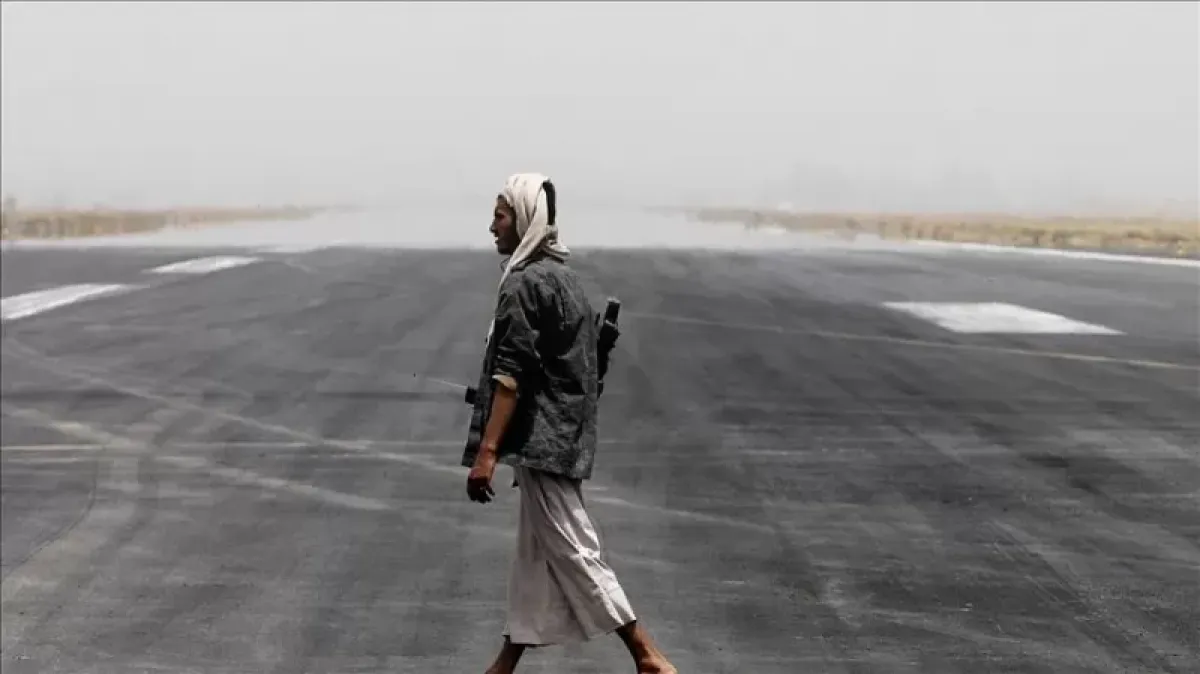
Unusual flight patterns and discrepancies in tracking data around Sana'a International Airport, controlled by Houthi militants, have sparked questions about the nature of certain arrivals, particularly those coinciding with United Nations and humanitarian flights.
A report authored by academic Dr. Abdulqader Al-Kharrraz and published by FraudWiki highlights concerning trends in air traffic over Yemen. The analysis, which compares flight tracking data with field observations, focuses on specific incidents at Sana'a Airport on August 24 and September 16. The report suggests the possibility that UN and humanitarian flights may be used as a cover for air traffic that is not fully visible on public tracking systems. However, it emphasizes that the nature of any cargo or beneficiaries would require an independent investigation for confirmation.
In a recent incident cited by Al-Kharrraz, a Boeing 767-232(BDSF) cargo aircraft reportedly landed at Sana'a Airport on Friday, September 18, at approximately 1:18 PM, departing around 3:00 PM after a stay of about one hour and 42 minutes. Yemeni media quoted Al-Kharrraz speculating that the aircraft might be linked to arrangements utilized by the Houthis, possibly through the UN or another entity, and that UN markings could be employed to mask smuggling or support operations, although these claims could not be independently verified.
Further questions arise from the report's observation of UN flight UNO136H on August 24. Tracking data indicated an unusual route for the aircraft after departing from Aden Airport, heading inland within Yemen before traversing the airspace of several governorates towards the vicinity of Sana'a. Concurrently, field observations documented another aircraft landing at Sana'a Airport whose data was not clearly visible on public tracking platforms. According to a separate report on the incident, the UN flight did not land in Sana'a according to available tracking data, despite its presence in the capital's airspace coinciding with the landing of another aircraft.
This raises the question of whether the unusual route of the UN aircraft provided aerial cover for the other aircraft. However, the published evidence does not establish deliberate coordination, nor does it identify the landing aircraft or the nature of its cargo. Available data for flight UNO136H indicates its appearance in tracking records during September, confirming its actual presence in regional air traffic, but this does not inherently prove any connection to illicit transport. Moreover, the absence of an aircraft from public tracking platforms does not necessarily mean its transmitter was off; gaps can result from weak coverage, data filtering, or other technical reasons.
These events open a more sensitive discussion regarding flights arriving directly at Sana'a Airport, given Houthi control, and whether all flights and cargo undergo adequate verification and inspection procedures, particularly when unknown or poorly tracked flights coincide with those bearing UN or humanitarian designations. The report's findings necessitate greater transparency in air traffic to Sana'a, confirmation of aircraft identities, cargo, and flight paths, and an investigation into flights whose declared data does not align with actual observations. It also calls for the UN to clarify the circumstances surrounding the movements of flight UNO136H and other flights that have raised suspicions.