Scientists are proposing a mind-bending theory that a long-overlooked particle might be the key to why the universe exists at all, centered on matter surviving the Big Bang.
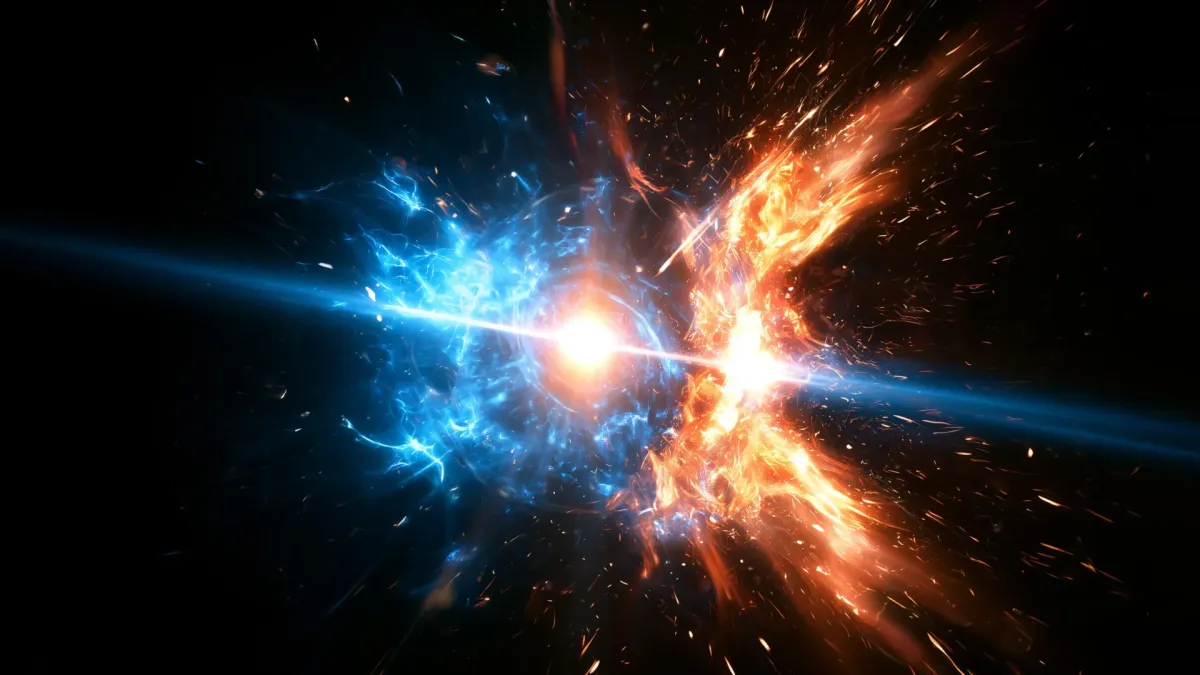
The puzzle physicists have grappled with is why the universe is brimming with matter instead of being a void. The prevailing idea is that the early universe produced matter and antimatter in near-equal amounts. However, when these two meet, they annihilate, releasing energy. If quantities were perfectly balanced, almost all matter should have vanished, leaving nothing for stars, planets, or life to form.
Researchers from the University of Southampton and the Indian Institute of Technology Kanpur believe a hypothetical, heavier relative of the neutrino – a particle known for its minimal interaction with ordinary matter – could be the missing piece. They focused on a 'decoupled' heavy neutrino, a particle generally considered too weakly linked to significantly impact the cosmos.
According to their calculations, this particle's remarkably long lifespan could have given it a much bigger role than previously assumed. As the universe cooled after the Big Bang, this heavy neutrino may have briefly dominated its energy density, altering the early cosmic evolution and creating conditions where matter could outnumber antimatter.
Dr. Rishav Roshan from the University of Southampton explained that this particle, often dismissed as background noise, decays so slowly that it "temporarily took over the energy density of the universe and triggered a matter-dominated period." This shift, the team suggests, influenced the temperature at which fundamental particles like electrons interacted with their anti-particles, indirectly shaping the matter-antimatter imbalance.
This new theory also hints at potential evidence within primordial gravitational waves – ripples in spacetime generated in the universe's infancy. Co-author Dr. Sudipta Show suggests that the heavy neutrino's temporary dominance could have left detectable imprints on these ancient signals, offering a new avenue for scientists to investigate the universe's earliest moments and solve the mystery of why matter prevailed.