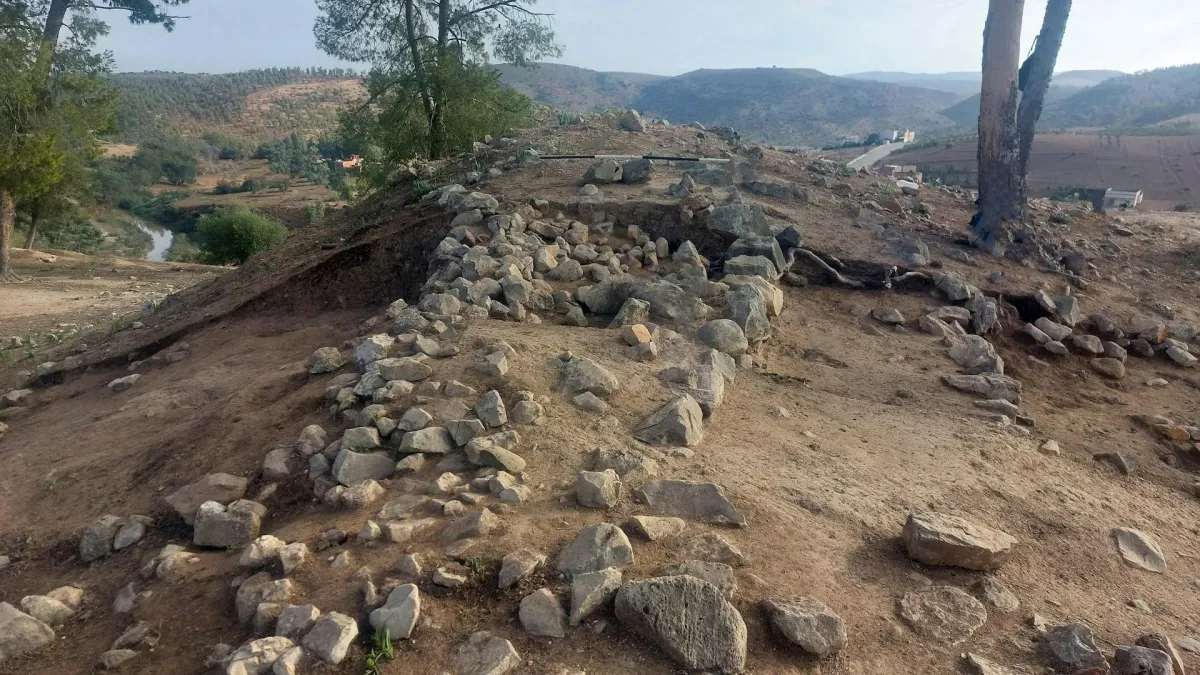
Archaeologists have uncovered a massive, 4,000-year-old defensive wall in northwest Morocco, significantly reshaping our understanding of early North African societies and their connections to the wider Mediterranean world. The discovery at Oued Beht suggests that communities during the second millennium BC were not only actively shaping their environment but were also involved in complex interactions across the region.
The Oued Beht Archaeological Project has previously unearthed Africa's earliest known large-scale agricultural complex outside the Nile Valley, dating back approximately 5,400 to 4,900 years. Recent excavations in 2023 have revealed a substantial, likely defensive structure, estimated to be between 4,000 and 3,500 years old. This finding represents the earliest large-scale construction of a potentially defensive nature in North Africa beyond Egypt.
While the exact threats the wall was built to counter remain unclear, researchers suggest it likely relates to increased competition over land, resources, and movement control, rather than external invasions. The construction indicates communities felt a need to protect themselves or assert dominance over strategic locations, pushing back the timeline for organized defensive architecture in the Maghreb and highlighting more complex societal structures than previously assumed.
The research also indicates the Oued Beht ridge was a focal point during the medieval period (11th-13th centuries AD), with the same defensive structure being rebuilt, a settlement established nearby, and a cemetery used. These findings offer rare archaeological insights into rural communities across millennia, shedding light on societal development in a region often overlooked in historical narratives.
The discoveries challenge the long-held view of the Maghreb's later prehistory being poorly understood due to fragmented evidence. Oued Beht has revealed a significant concentration of human activity, with evidence of farming, craft production, and sophisticated tool-making, suggesting it was a major hub in prehistoric northwest Morocco.
The ancient wall, initially noted in the 1930s, has now been clarified through new excavations as a multi-phase ditch, rampart, and wall system designed to protect the ridge's southern tip. Radiocarbon dating places its initial construction during a period equivalent to the Bronze Age in the western Mediterranean, confirming its status as the earliest defensive construction of its kind outside Egypt.
Building such a structure points to a society capable of significant planning, coordination, and labor mobilization. The shift in focus from a more open area to the defensible southern ridge during this period may signal evolving settlement strategies. The dynamic Mediterranean landscape of the second millennium BC, with complex societies like those in southern Iberia, suggests that North Africa was not isolated but participated in broader regional transformations, possibly influenced by growing competition and the need for more formalized leadership.