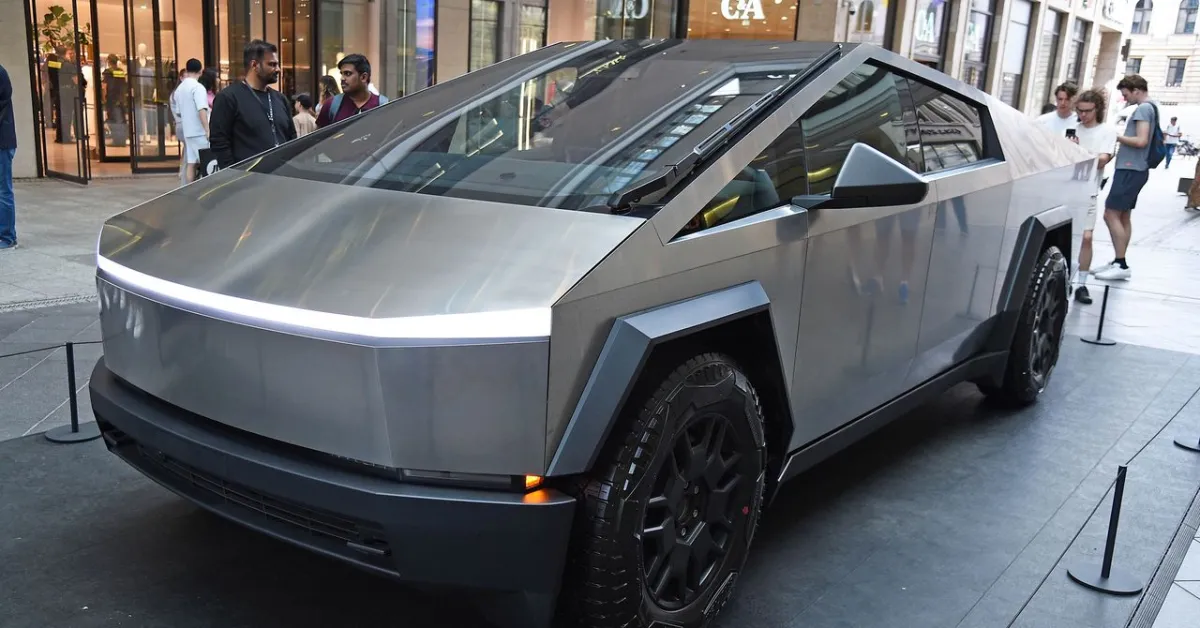
Tesla is reportedly shelving production of the polarizing Cybertruck at its Texas Gigafactory next year, and this move might actually be a win for the broader electric vehicle market.
The Cybertruck, with its distinctive design and controversial associations, faced sales challenges and a number of recalls. Its discontinuation hints at a potential cooling-off period for massive electric vehicles, especially trucks. This trend is beneficial for pedestrian and cyclist safety, and it also eases pressure on the battery supply chain at a time when more drivers are looking to go electric.
The Cybertruck packed a hefty 123 kilowatt-hour battery, weighing around 1,600 pounds—about a quarter of the truck's total weight. This is comparable to the battery in Ford's F-150 Lightning, another electric truck that was axed late last year, alongside a three-row EV. Ford's electric trucks utilized batteries ranging from 98 to 131 kilowatt-hours.
The simultaneous cancellation of these large electric trucks, coupled with automakers announcing more compact EVs and extended-range hybrid options, suggests a significant market pivot. Ford is set to release the Fathom, an electric pickup priced under $30,000, expected to be similar in size to the compact Maverick. While specific battery sizes haven't been revealed, they're likely to be considerably smaller than those in the F-150 Lightning or Cybertruck. Ford also plans to reintroduce the Lightning with an extended-range model.
Emerging players are also focusing on smaller, more affordable EVs. Startup Slate is developing a tiny electric pickup that can convert into an SUV, with a base model starting below $25,000. It features a smaller battery and has garnered substantial preorders. Rivian's new R2 SUV, while not as small or cheap as Ford's and Slate's offerings, still comes with a smaller 88 kilowatt-hour battery and weighs around 1,200 pounds, making it more compact than the R1S. Rivian has also teased an even smaller SUV, the R3, for future release.
While large EVs like the Kia EV9 and Rivian R1S are still selling well, and the F-150 Lightning enjoys a strong used market, the bulk of top-selling new EVs are mid-sized SUVs, crossovers, and sedans with moderate battery capacities. Many newly announced EVs are trending smaller or are designed as range-extending vehicles.
Opting for smaller vehicles is a key strategy to make EVs more accessible. Less weight means smaller, less expensive batteries, which can help automakers offer more affordable options as the price of many consumer goods continues to climb. The average transaction price for a new EV currently sits around $55,800. Furthermore, building smaller vehicles optimizes the use of a limited battery supply chain. Most drivers use their vehicles for daily tasks like commuting and errands, tasks that can be effectively handled with smaller batteries, as demonstrated by vehicles like the Hyundai Ioniq 5.
Even Elon Musk's decision to end Cybertruck production points to market trends, with Tesla shifting focus to producing more Cybercabs, which reportedly feature a smaller 48 kilowatt-hour battery.