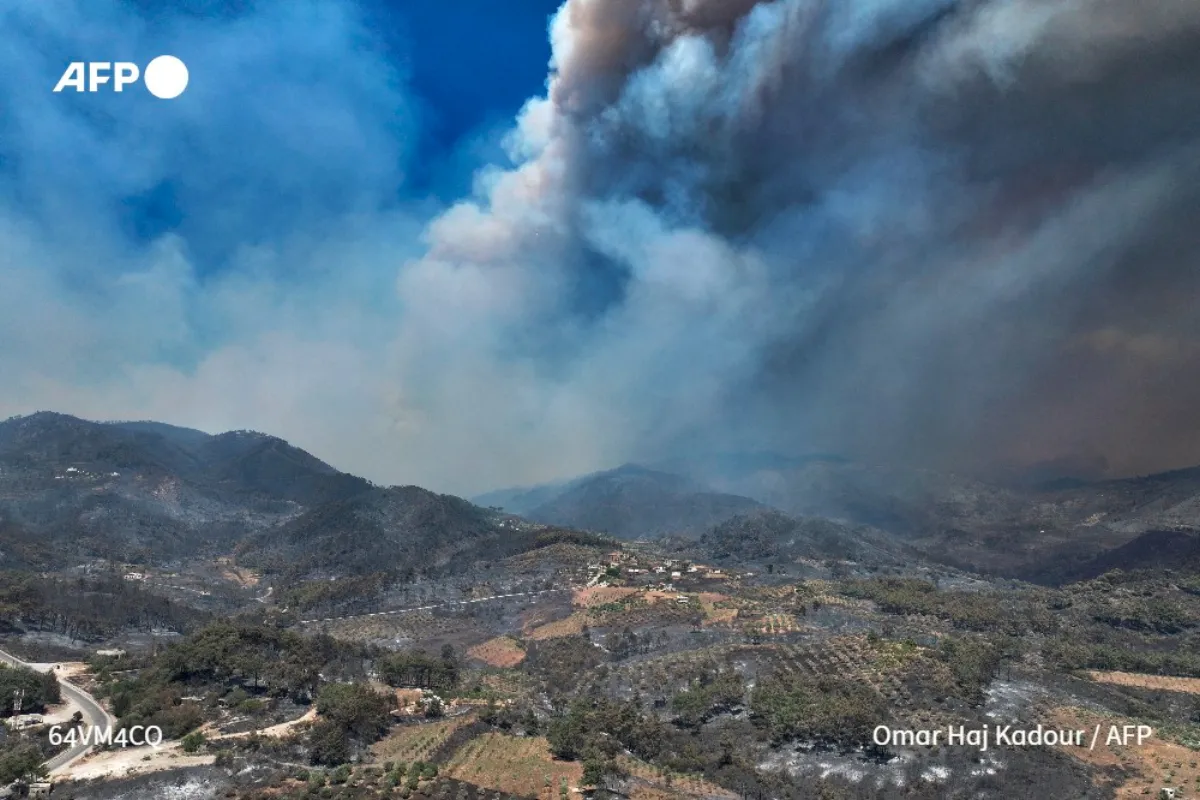
The military said it had struck around 800 Hezbollah targets as part of the deadliest strikes on Lebanon since fighting started last October.
“Since this morning, the IDF (military) has conducted proactive and extensive aerial strikes against Hezbollah terrorist targets in Lebanon,” a statement said, adding that the strikes hit “approximately 800 Hezbollah terror targets in southern Lebanon and in the area of Bekaa deep inside Lebanese territory.”
Lebanon’s state-run National News Agency also said that Israel was conducting new raids across Lebanon’s east just hours after deadly strikes on the south and east.
“Enemy raids targeted the mountain” areas in the Baalbek region and several towns and villages, NNA reported, adding that “the Israeli enemy” launched a strike on the town of Hermel.
Israel on monday unleashed its most widespread wave of airstrikes against Hezbollah while warning Lebanese citizens to evacuate areas where the armed group was storing weapons.
“We are preparing for a large-scale and targeted strike in Bekaa Valley,” military spokesman Rear Admiral Daniel Hagari said earlier in the afternoon at a media briefing, adding that residents should “distance themselves” from Hezbollah sites “for your safety and protection.”
“Hezbollah stores its strategic weaponry in civilian buildings and uses the population as human shields,” Hagari said.
“The houses in Bekaa have rockets and drones. We will attack them before they pose a threat to the residents of Israel.”
As a result of the heavy Israeli bombardment, hundreds of people in south Lebanon have fled seeking safety.
Bilal Kachmar, an official at the disaster management unit in Tyre, said “hundreds of displaced people rushed to” a school-turned-shelter in the southern city, with many others “camping out in the streets.”
AFP correspondents in the south saw rows of cars leaving nearby Sidon.
Separately, the Lebanese interior minister said that it opened schools in Beirut, Tripoli and eastern and southern Lebanon as shelters amid “heavy displacement.”
Speaking to Al Arabiya, Interior Minister Bassam al-Mawlawi said that he hoped the Lebanon “doesn’t turn into a second Gaza.”
Al-Mawlawi also told Al Arabiya that he hoped that “we do not reach a total war on Lebanon.”
Israeli Defense Minister Yoav Gallant said in a video published by his office on Monday said that “We are deepening our attacks in Lebanon, the actions will continue until we achieve our goal to return the northern residents safely to their homes.”
“These are days in which the Israeli public will have to show composure.”
He was speaking after the Israeli military targeted Iran-backed Hezbollah in Lebanon’s south, eastern Bekaa valley and northern region near Syria.
The latest attacks came amid some of the heaviest cross-border exchanges of fire in almost a year of conflict raging alongside the war between Israel and Hamas in Gaza.
Earlier, Israeli army spokesperson Avichay Adraee said that airstrikes on houses in Lebanon, in which “Hezbollah hid weapons” were imminent.
Residents of southern Lebanon received calls from a Lebanese number ordering them to immediately distance themselves 1,000 meters (3,280 feet) from any post used by Hezbollah, a Reuters reporter in the south, who received the call, said.
Lebanese state media confirmed on Monday that people were receiving Israeli phone warnings telling them to evacuate.
“Citizens in Beirut and a number of areas are receiving landline telephone warning messages whose source is the Israeli enemy, asking them to quickly evacuate where they are,” the NNA said, describing the warning as “part of the psychological war that the enemy has adopted.”
The office of Lebanon’s caretaker Information Minister Ziad Makary also received a message to evacuate the premises, NNA said.
Makary’s office, located in Beirut near several other ministries, said it received a landline call and when staff responded, a “recorded message” told them to evacuate the building in order to avoid strikes.
Imad Kreidieh, head of state telecommunications provider Ogero, said “the landline network system in Lebanon blocks all communications from Israel.”
But Israel “circumvents the communications systems by using the international phone code of a friendly country,” he told AFP.
Kreidieh also told Reuters that Lebanon received more than 80,000 suspected Israeli call attempts asking people to evacuate their areas
Such calls were “psychological warfare to make havoc and chaos,” he added.
A Lebanese person living in Beirut’s Manara area said her family received a call on their landline.
“So they were freaking out, I am freaking out as well because we thought somehow the area we live in is safe because we’re surrounded by ambassadors,” said the person.
“The Saudi embassy is very close, like two minutes walking distance from us, but apparently they are targeting everyone now. It was a long 30-40 second message.”
Lebanon’s education ministry expanded the closure of schools and universities to include institutions across the country amid intensified Israeli airstrikes after having previously limited the closure to certain areas.
In a televised statement earlier in the day, Hagari issued a similar warning and said it was being “distributed in Arabic on all networks and platforms in Lebanon.”
Asked by reporters about a possible Israeli ground incursion into Lebanon, Hagari said “we will do whatever is needed” in order to return evacuated residents of northern Israel to their homes safely, a war priority for the Israeli government.
Hagari presented in a media briefing an aerial video of what he described as Hezbollah operatives trying to launch cruise missiles from a civilian house in Lebanon, and the subsequent Israeli strike moments before it was launched.
“Hezbollah is endangering you. Endangering you and your families,” Hagari said.
The UNIFIL peacekeeping force in southern Lebanon had “seen an intensification of bombardments throughout the area of operations, close to the Blue Line but also deeper south,” its spokesperson Andrea Tenenti told Reuters, referring to the line demarcating the Lebanese-Israeli border.
The Israeli military said it had launched a new wave of attacks against Hezbollah in southern Lebanon on Monday.
“The [Israeli Army] is currently conducting strikes on terror targets belonging to the Hezbollah terrorist organization in southern Lebanon,” the military statement said.
There was no immediate comment from Hezbollah.
Low flying warplanes
Israeli warplanes carried out an intense wave of airstrikes on towns along Lebanon’s southern border and even further north on Monday morning, according to Reuters witnesses.
A rocket hit an uninhabited mountainside east of the Lebanese port city of Byblos on Monday, a resident and Lebanese state media said, in an area that has not previously been hit by airstrikes. The area falls between Christian and Shia villages.
Reuters reporters in the southern port city of Tyre could hear warplanes flying low over southern Lebanon and hear a series of airstrikes nearby.
Hezbollah’s al-Manar television reported Israeli airstrikes targeting the outskirts of many towns and villages in the south and the Bekaa Valley in eastern Lebanon. Footage showed columns of smoke rising over the south.
Warplanes also carried out airstrikes on the Hermel area in northern Lebanon, Hezbollah’s al-Manar reported.
Lebanon’s health ministry said at least one person was killed and six wounded in the Israeli strike on the Hermel region. Another 11 were wounded in a strike on the southern town of Aitarun, the ministry said in a statement.
The Gaza war and the conflict between Israel and Hezbollah has raised concerns that the United States and Iran, which has proxies across the region, could get sucked into a wider conflict.
Gallant said on X on Monday that he had spoken with US Secretary of Defense Lloyd Austin about the military’s latest strikes against Hezbollah in Lebanon.
“We also discussed the wider regional situation and the threats posed by Iran and its proxies,” he added.
Hezbollah deputy chief Naim Qassem told mourners at the funeral of one of the group’s commanders killed last week in Beirut: “We have entered a new phase, the title of which is the open-ended battle of reckoning.”
Hezbollah has come under intense pressure since thousands of pagers and walkie-talkies used by Hezbollah members exploded on Tuesday and Wednesday.
The attack, an unprecedented breach of security, was widely blamed on Israel, which has not confirmed or denied responsibility.
On Friday, an Israeli airstrike on Beirut’s southern suburb targeted senior Hezbollah commanders killing 45 people, according to the Lebanese health ministry. Hezbollah said 16 members of the group were among the dead, including senior leader Ibrahim Aqil and another commander, Ahmed Wahbi.
Israel expands Lebanon strikes in deadliest wave of raids
1 year ago