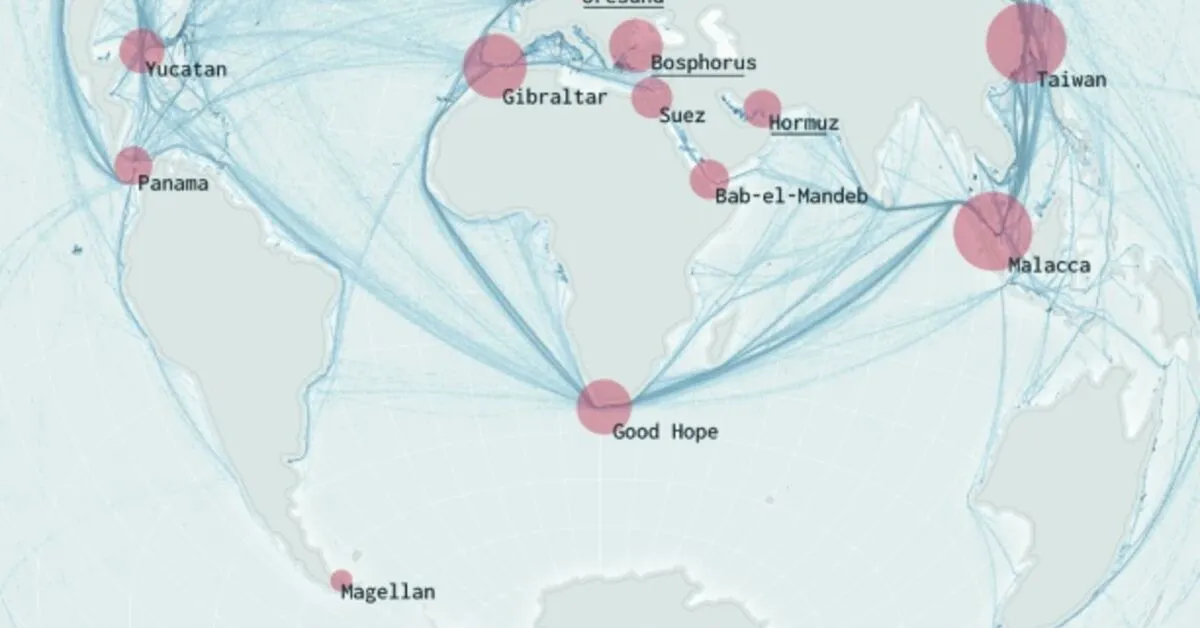
Maritime straits, including the Strait of Hormuz and the Strait of Malacca, have historically been critical nodes for global trade and recurring sources of geopolitical friction. Current events in the Red Sea and the Persian Gulf underscore their enduring strategic significance.
Experts observe that as Iran intensifies its control over the Strait of Hormuz, its Houthi allies in Yemen are reportedly seeking to disrupt shipping in the Red Sea. This disruption could extend to the Bab el-Mandeb strait, a crucial passage for vessels en route to the Suez Canal. These two chokepoints, along with approximately a dozen other straits globally, are indispensable for international commerce, facilitating the transit of oil tankers, cargo ships, and vessels carrying raw materials and finished goods.
The United Nations Convention on the Law of the Sea (UNCLOS), often referred to as the constitution for the oceans, establishes that straits are natural features where the principle of free navigation must be upheld, and tolls are prohibited. Unlike man-made canals such as Panama or Suez, which can levy charges, straits are governed by international law. While Iran has not ratified the Montego Bay Convention, it has historically adhered to its principles under customary international law.
Historically, the strategic importance of these waterways has been recognized for centuries. As early as 1507, Portugal attempted to control the Strait of Hormuz to monopolize trade routes to the East. However, the early 17th century saw the prevailing Mare Liberum doctrine, championed by Hugo Grotius, assert that the sea belongs to no one and that freedom of passage through straits is essential for international trade. This principle was subsequently adopted and defended by maritime powers like the Netherlands, Britain, and the United States.
Despite the principle of free navigation, major powers have leveraged the geography of straits for strategic advantage. For instance, Britain established key military bases along vital maritime routes, including Singapore to control the Strait of Malacca and bases near Bab el-Mandeb to secure access to the Red Sea. In Europe, the Danish straits were significant in the 19th century for enabling Denmark to collect tolls and for controlling access to the Baltic Sea for other powers.
The Turkish Straits (the Bosphorus and Dardanelles) remain a notable exception, with tolls still collected under the 1936 Montreux Convention. Looking ahead, the Strait of Taiwan and the Strait of Malacca are identified as potential future flashpoints due to territorial ambitions and economic considerations. Provocative actions, such as the alleged "war of sand" in the Taiwan Strait, highlight ongoing tensions. Moreover, proposals to implement tolls in straits like Malacca, if realized, could significantly impact regional economic hubs and trade dynamics.