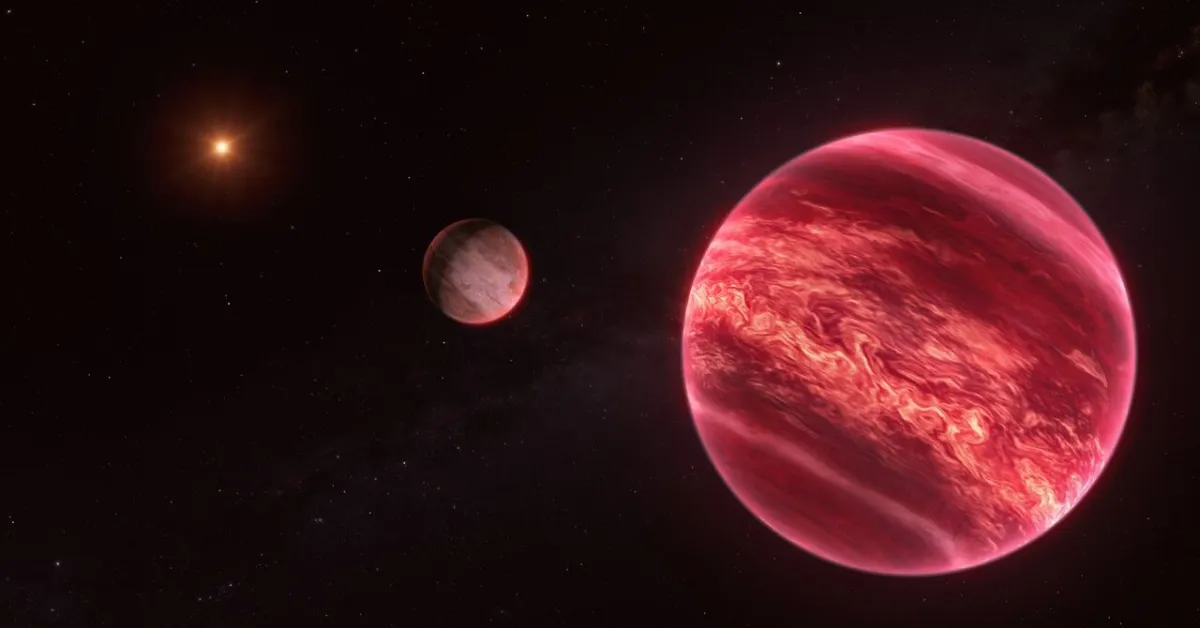
For the first time ever, scientists have detected what appears to be a moon-like object outside our solar system, orbiting a brown dwarf 73 light-years away. While researchers are calling it an "exosatellite" and grappling with how it fits the definition of a moon, the discovery could shake up our understanding of planetary formation.
The international research team focused on a system around the brown dwarf CD-35 2722 B, a celestial body more massive than a planet but not quite a star. Using advanced infrared spectrographs on the European Southern Observatory's Very Large Telescope, they employed the Doppler method. This technique tracks the subtle wobble of CD-35 2722 B caused by the gravitational pull of another body, revealing crucial details about its potential companion.
Published in Nature, the analysis revealed a strong signal pointing to a massive object with a period of about 170 days and a mass at least 0.9 times that of Jupiter. This potential exomoon accounts for a significant 2.5 percent of the brown dwarf's mass, a proportion far greater than any moon-planet pair in our own solar system.
To rule out other explanations, the team meticulously checked for potential errors from Earth's orbit, atmospheric conditions, and the brown dwarf's rotation. Calculations also confirmed that the orbiting body resides within a stable zone, beyond the brown dwarf's disruptive tidal forces but within its gravitational influence.
This finding marks a significant step, following earlier hints of satellites around other celestial bodies. However, the unique nature of this system, blurring the lines between stars, planets, and moons, makes classifying the object challenging, especially since there's no official definition for exomoons yet. Researchers believe this discovery will spur new theories on celestial mechanics and could even hint at habitable environments around distant rocky exomoons, potentially broadening the search for alien life.