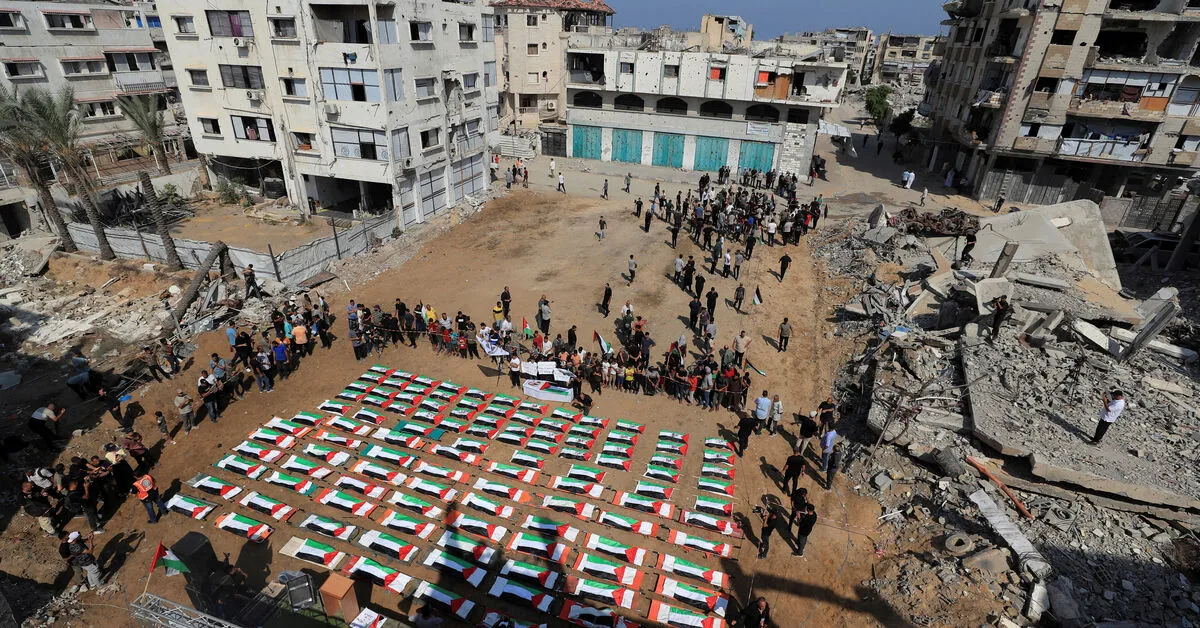
The decomposed remains of 112 individuals, all belonging to the Al-Hassayna clan, were honored in a somber mass funeral in Gaza, marking the largest such ceremony of the ongoing conflict. The recovered bodies represent a significant portion of the clan members killed nearly three years ago when Israeli airstrikes destroyed residential buildings.
According to Palestinian authorities, 308 members of the Al-Hassayna family, also known as the Abu Sharia, perished on November 22, 2023, in Sabra, a neighborhood in Gaza City. At the time, Israeli airstrikes collapsed apartment buildings where residents were sleeping. While approximately half of the deceased were recovered earlier, 153 bodies remained buried beneath the rubble until a recent recovery effort.
A team of 40 workers spent 17 days meticulously sifting through the debris, successfully retrieving the remains of 112 missing victims. The recovery operation concluded with a funeral procession where the flag-shrouded bodies were carried through the streets. Taysir Al-Hassayna, a surviving clan member, expressed deep sorrow but also faith, stating, "This day is mixed with grief, and it has reopened our wounds three years after this massacre."
Reuters was unable to obtain an official statement from the Israeli military detailing their account of the November 2023 strike, which occurred in the early weeks of the war. The Israeli military did not immediately respond to a request for comment regarding the incident. Palestinian health authorities report that over 73,000 Palestinians have been confirmed killed in the war, with an estimated 8,000 more believed to be under the rubble.
Omar Al-Hassayna, 65, who survived the bombing and is currently in Egypt, wept while watching footage of the funeral. His wife, four adult sons, and four grandchildren were among those killed. "They are pieces of me," he said, reflecting on the daily impact of his loss. "The funeral today is the least that could be done for those martyrs. It is time for those bodies... to rest in peace."
The Al-Hassaynas, a Bedouin clan known for their generosity, had resided in Sabra for decades. Omar explained that the strikes hit three buildings where family members had gathered for shelter. He survived the partial destruction of one building with minor injuries, while his daughters and a son also escaped. The recovery of bodies has been largely confined to areas outside Israeli military control.
Mahmoud Basal, spokesperson for Gaza's Civil Defence, detailed the challenging identification process, which involved forensic evidence and survivor testimonies, including recognition through clothing, injuries, and personal items like jewelry. He noted that with more equipment, such recovery operations could be completed more efficiently. The recovered remains were finally laid to rest in a graveyard amidst the ruins of Gaza.