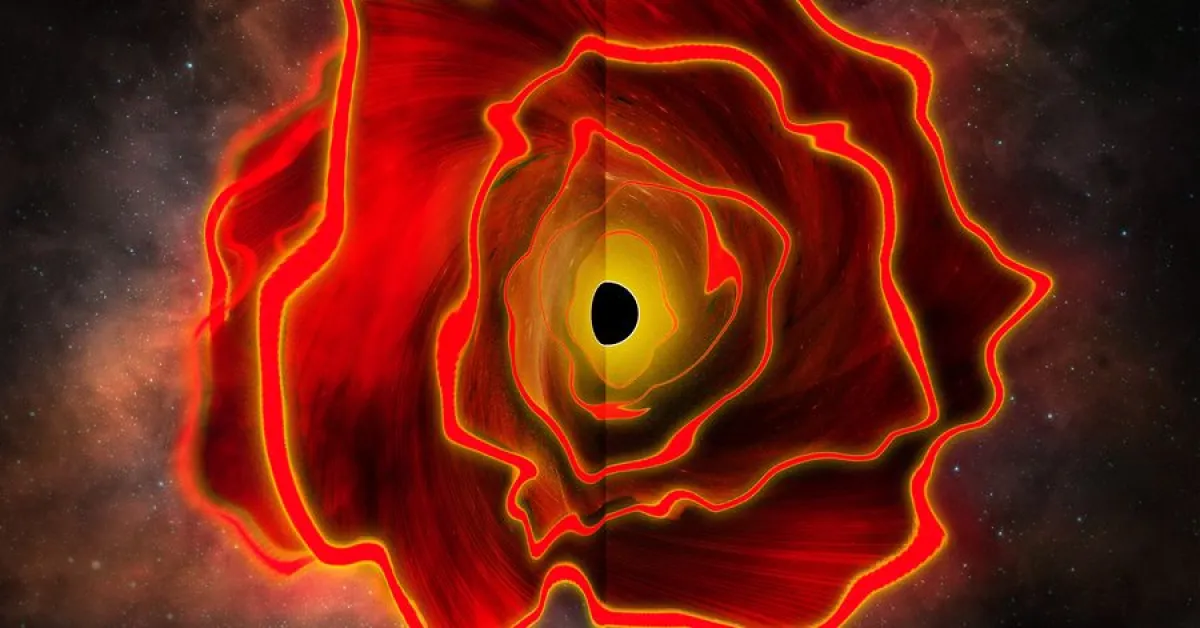
Astronomers using the James Webb Space Telescope (JWST) have identified compelling evidence for "black hole stars," massive objects in the early universe that appear stellar but are likely supermassive black holes shrouded in gas.
These newly observed phenomena, detailed in a study published in Nature, challenge existing cosmic models. The object, designated MoM-BH*-1, is comparable in size to our solar system and emits a brilliant red glow. While its light signature initially suggested a giant star, its extreme brightness and peculiar light absorption patterns point to a different explanation.
Scientists estimate that MoM-BH*-1 radiates about 100 billion times more energy than a typical star could generate through nuclear fusion. This energy output is exceptionally high, even for the universe's early stages, approximately 660 million years after the Big Bang. Researchers hypothesize that an immense, dense gas cloud surrounding a central black hole is responsible for absorbing specific light wavelengths, creating the observed effects.
The "black hole star" hypothesis offers a potential solution to another puzzle presented by JWST observations: the frequent discovery of unexplained red spots in the early universe. These objects have defied easy categorization, with previous theories suggesting they could be star-filled galaxies or dust-obscured black holes. The concept of black hole stars provides a unified explanation for these mysterious early cosmic structures.