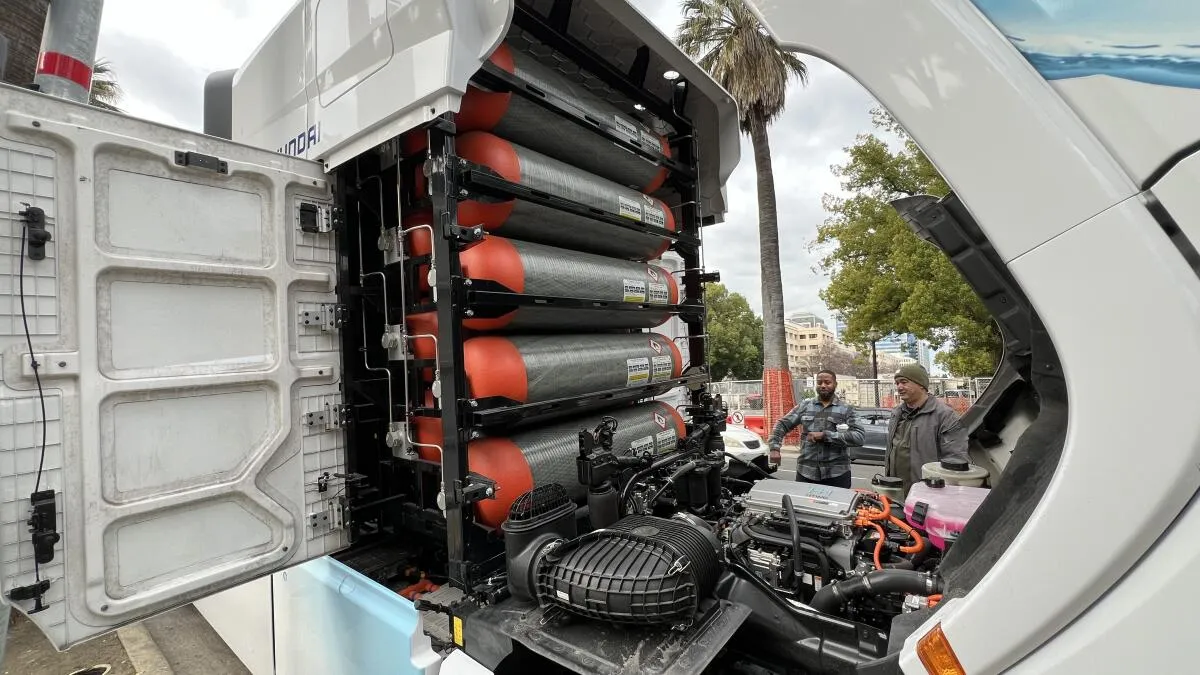
California's ambitious vision for a green hydrogen-powered future, intended to significantly contribute to the state's climate strategy, has encountered substantial setbacks due to market volatility, reduced federal funding, and numerous project cancellations. The once-promising alternative fuel, lauded for its potential to eliminate greenhouse gas emissions during use, is now facing a period of market uncertainty, leaving its widespread adoption in question.
Advocates within the nascent hydrogen industry continue to express optimism about the fuel's potential, despite a backdrop of industry consolidation and stalled initiatives. However, industry insiders acknowledge the significant hurdles, particularly the scarcity of buyers needed to justify expanded fuel production. While hydrogen is promoted as a clean alternative to gasoline, diesel, and natural gas, the vast majority of current hydrogen production relies on natural gas, a process that generates greenhouse gases. The clean production of hydrogen, typically achieved by splitting water using renewable electricity, is prohibitively expensive due to high energy demands and specialized equipment costs.
The state's initial push for hydrogen infrastructure, exemplified by former Governor Arnold Schwarzenegger's "hydrogen highway" initiative in 2004, has largely been overshadowed by the ascendancy of electric vehicles. Battery-powered cars have become more affordable and popular, diminishing the focus on hydrogen fuel cell vehicles. Consequently, the number of registered hydrogen cars in California has declined, and the network of hydrogen fueling stations has seen a reduction, with a significant portion of existing stations experiencing operational issues.
California has attempted to pivot its hydrogen strategy towards heavier transportation sectors, including buses, trucks, and port equipment, but these efforts have also faced considerable challenges. While there are a limited number of hydrogen-powered buses and trucks currently in operation, scaling up the necessary production and distribution infrastructure remains a complex problem. Many environmental organizations have expressed skepticism regarding the viability of green hydrogen, citing its high production and distribution costs and arguing that battery technology offers a more efficient and practical solution for decarbonization.
Further complicating the landscape, federal support for hydrogen initiatives has wavered, with significant grant funding for West Coast hydrogen hubs being withdrawn. This, coupled with the struggle of hydrogen projects to reduce costs independently, has led to project cancellations and a general slowdown in development. The cost per mile for hydrogen fuel in California remains significantly higher than for gasoline, and the market penetration of hydrogen trucks and buses lags far behind electric alternatives. Vehicle manufacturers and fleet operators are hesitant to invest in hydrogen technology without greater certainty regarding the availability and reliability of both the fuel and fueling infrastructure.
The state grapples with a "chicken and an egg" dilemma, where the development of fueling stations is contingent on vehicle adoption, and vice versa. The high cost of building fueling stations and the logistical difficulties in securing reliable fuel deliveries present substantial barriers. Recent incidents, such as a trailer explosion that disrupted fuel supply, have exacerbated these challenges. Consequently, advanced hydrogen-powered equipment often sits idle due to a lack of fuel. While some transit agencies remain committed to hydrogen, they acknowledge the need for caution and careful observation of market developments due to the high costs involved.
California's current hydrogen supply for transportation primarily comes from natural gas-based facilities, with limited green hydrogen production. Although plans are underway to expand small-scale green hydrogen production to serve a growing number of heavy-duty vehicles, the broader vision for extensive green hydrogen production and distribution networks faces significant obstacles, including the lack of a robust customer base. Hopes are now pinned on utility companies potentially increasing demand for green hydrogen to meet renewable energy targets. Nonetheless, plans by local utilities to incorporate hydrogen into their energy generation mix have faced opposition from environmental groups concerned about water usage, potential pollution, and the overall efficiency compared to direct electrification.