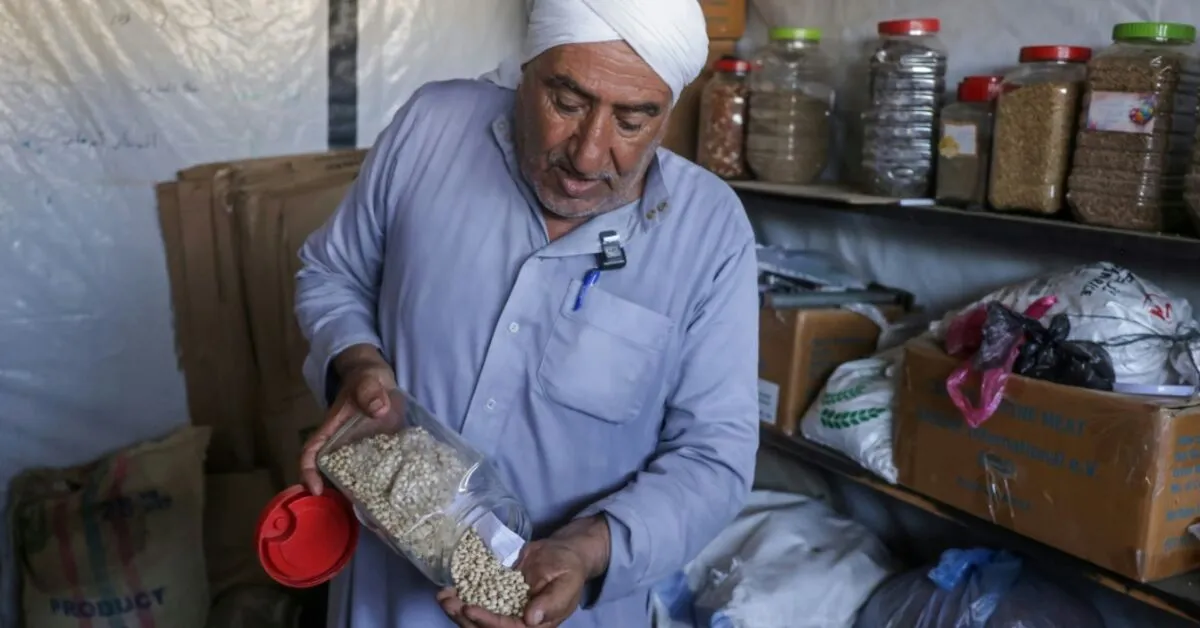
In the central Gaza Strip, a dedicated team is painstakingly rebuilding the Al Qarara Seed Bank from makeshift conditions, safeguarding local heirloom seeds crucial for reviving the territory's devastated agricultural sector and preserving its heritage.
The seed bank, located in Deir el-Balah, lost its original stock of indigenous seeds during the conflict that erupted in October 2023. Unlike commercially sold hybrid varieties, these heirloom seeds, which have been cultivated for generations, can be saved and replanted annually, offering superior adaptation to local environmental conditions. Salem Muhanna, the project manager, highlighted their importance, stating, "During the war, they were what helped us survive. Heirloom seeds give continuity. They provide 80 to 90 percent of the same yield repeatedly. That is why we relied on heirloom seeds."
The collection includes seeds for staple crops such as wheat and barley, leafy greens like Swiss chard, spinach, and parsley, and vegetables including courgette and okra. The war, which followed Hamas's attack on Israel, inflicted severe damage. "The fighting completely destroyed the bank and led to the loss of many seed varieties," explained Hanadi Muhanna, Salem's daughter and co-manager. "In addition, because we were repeatedly displaced, it was difficult to start over again. Eventually we settled in Deir el-Balah and managed, thankfully, to establish a small tent. We created something simple using basic means." The current collection is housed in hessian sacks, plastic barrels, and mismatched tubs, carefully labelled and protected.
Gaza's agricultural sector has been severely impacted by the conflict. The United Nations' Food and Agricultural Organisation (FAO) reports that only three percent of the cropland remains accessible and undamaged. Compounding these challenges are stringent Israeli controls on the entry of essential goods. "There is no water, no fertiliser, no agricultural chemicals. Nothing is available," Salem Muhanna stated. Prior to the war, agriculture constituted approximately 10 percent of Gaza's economy, with the territory being self-sufficient in fresh vegetables and exporting a third of its produce. Currently, agricultural output is estimated to meet no more than 10 percent of Gaza's vegetable needs.
The Al Qarara Seed Bank operates on a lending system, where farmers receive seeds and return an equivalent amount at the end of the season. Suleiman Abu Shamas, a local farmer, described the project as a vital safeguard. "With agricultural supplies cut off and prevented from entering through the crossings, the only safeguard we had was to build a food basket based on heirloom seeds that already existed within Gaza." Osama Al-Mukhalalati, an economic security officer with the International Committee of the Red Cross (ICRC), views the bank as more than just a source for food production; it is a means of preserving Gaza's agricultural heritage. He concluded, "We consider this project a ray of hope amid the complete darkness hanging over the agricultural sector."