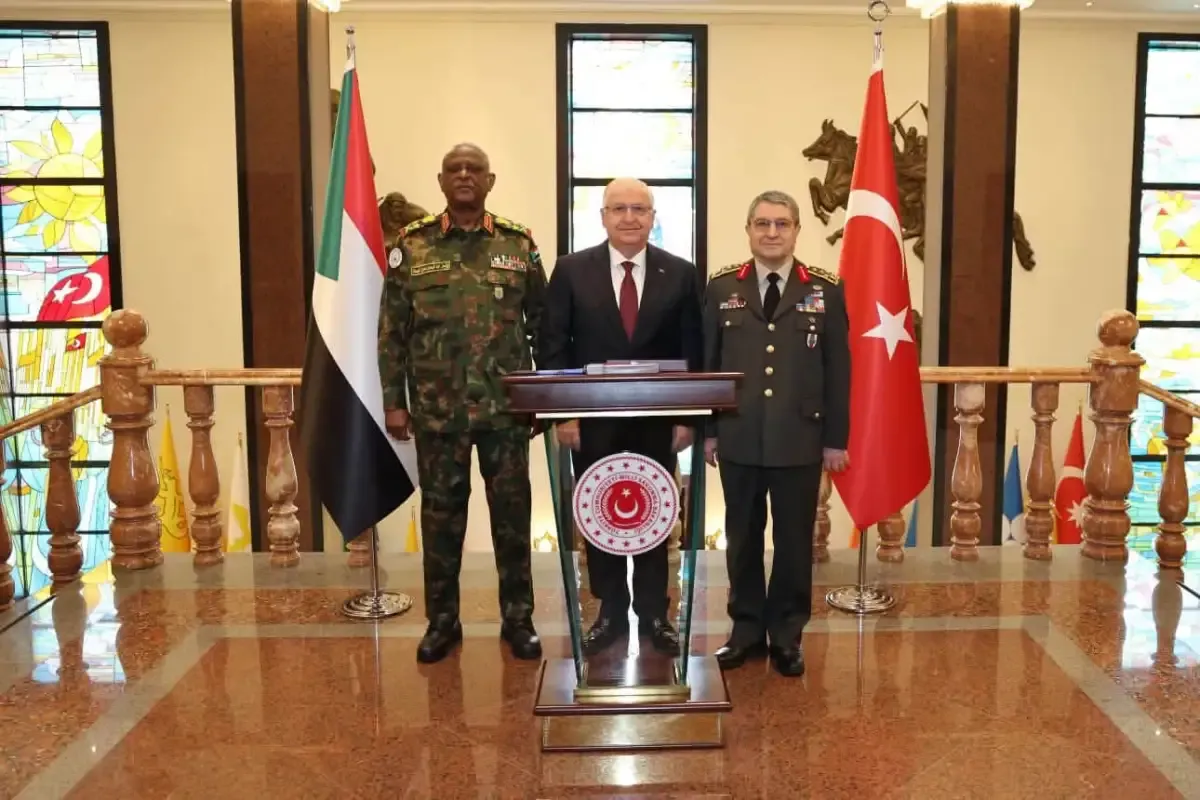
Recent external activities by leaders of the Port Sudan forces extend beyond the search for weaponry and military support, revealing a more complex agenda intertwined with military calculations and the restructuring of Sudanese Islamist networks abroad amidst the ongoing war.
The visit of the Assistant Commander-General of the Port Sudan forces, Yasser Al-Atta, to Turkey is highlighted as a key juncture in this trajectory. Information suggests that discussions were not confined to military needs but also encompassed undisclosed communications with prominent figures of the Sudanese Islamic Movement residing in Turkey, including former Director of Sudan's National Intelligence and Security Service, Lieutenant General Mohamed Atta Al-Mawla Abbas. According to sources cited by "Erem News," Port Sudan aims to enhance military cooperation with Ankara, focusing on drones, air defense systems, counter-drone capabilities, electronic warfare, and precision munitions, in addition to training, maintenance, and the transfer of technical support to Sudan, particularly in the Suakin region. Turkish interests appear to extend beyond arms deals, with opportunities presented in sectors such as ports, energy, mining, agriculture, and reconstruction, granting Ankara an economic and strategic foothold on the Red Sea. This suggests a potential relationship akin to a mutual influence pact, where the Sudanese side benefits from military support, and Turkey gains economic opportunities and political leverage in post-war arrangements.
A more controversial aspect of Al-Atta's visit involves a parallel organizational agenda. Sources report an unannounced meeting in Turkey with Mohamed Atta Al-Mawla, attended by other figures from the Islamic Movement. This development, if accurate, signifies the continuation of communication between military leadership and Islamist networks associated with the previous regime operating outside Sudan. Turkey holds particular significance as a primary location for Sudanese Islamic Movement leaders and affiliates. The appointment of Mohamed Atta Al-Mawla to manage the Movement's office in Turkey, following internal disputes among factions linked to prominent Islamist leaders, further solidifies Ankara's importance as a potential hub for reorganizing these networks.
These maneuvers are not limited to Turkey. Al-Atta's visit coincides with other activities indicating an expansion of external contacts for the Islamist current involved in the conflict. Sources link meetings held in Omdurman in April, where Al-Atta convened with leaders of the Al-Bara'a Brigades and other Islamist-affiliated formations, to promises of overseas training. This is concurrent with the visit of the Al-Bara'a Brigades' commander to China. This synchronicity raises questions about a parallel external track encompassing arms procurement, training, and the rebuilding of Islamist networks abroad, especially as the war intensifies its reliance on drones, air defense, and electronic warfare.
Political analyst Ibrahim Mattar indicates that Turkish military cooperation with Port Sudan forces commenced before Al-Atta's recent visit, citing a contract reportedly signed in November 2023 for the purchase of Bayraktar TB2 drones and related equipment, as well as the presence of Turkish company technicians in Sudan at later stages of the war. Mattar also noted the use of Akıncı heavy drones by Port Sudan forces, offering greater range, payload, and reconnaissance capabilities compared to lighter drones. He believes the introduction of new systems into the conflict zones could alter the balance of power, particularly in Kordofan and Blue Nile.
From a political perspective, Aroo Al-Sadeq, Assistant Chairman of the Umma National Party, views the nature of Al-Atta's meetings in Turkey with Turkish military officials as confirming the visit's military and strategic character, rather than a mere protocolary engagement. He suggests that Port Sudan seeks to transition its relationship with Ankara from an arms supplier to a long-term partnership encompassing defense, energy, ports, and reconstruction. However, the risk extends beyond arms deals, encompassing the potential for the Sudanese conflict to become a theatre for re-establishing the influence of political and military organizations linked to the former regime, exploiting the multiplicity of regional and international power centers. As external support channels widen, it becomes increasingly difficult to disentangle the military institution's needs from the interests of forces and organizations seeking to secure their position in a post-war Sudan.
Thus, the map of movements stretching from Omdurman to Ankara and Beijing appears to be more than a series of isolated visits; it indicates, based on available data, an attempt to construct an external network integrating arms, training, funding, and political and organizational relations. With the war ongoing, the next battle may not only be about territorial control but also about who successfully builds the network of influence that will shape Sudan after the fighting ceases. In this equation, the risk emerges that external support, rather than being a means to resolve the war, could become a tool to reshape the political and military landscape, prolonging the conflict and complicating prospects for a comprehensive settlement.