New findings from the James Webb Space Telescope (JWST) suggest that massive galaxies in the early universe might be up to four times heavier than previously estimated, thanks to a hidden population of numerous small stars.
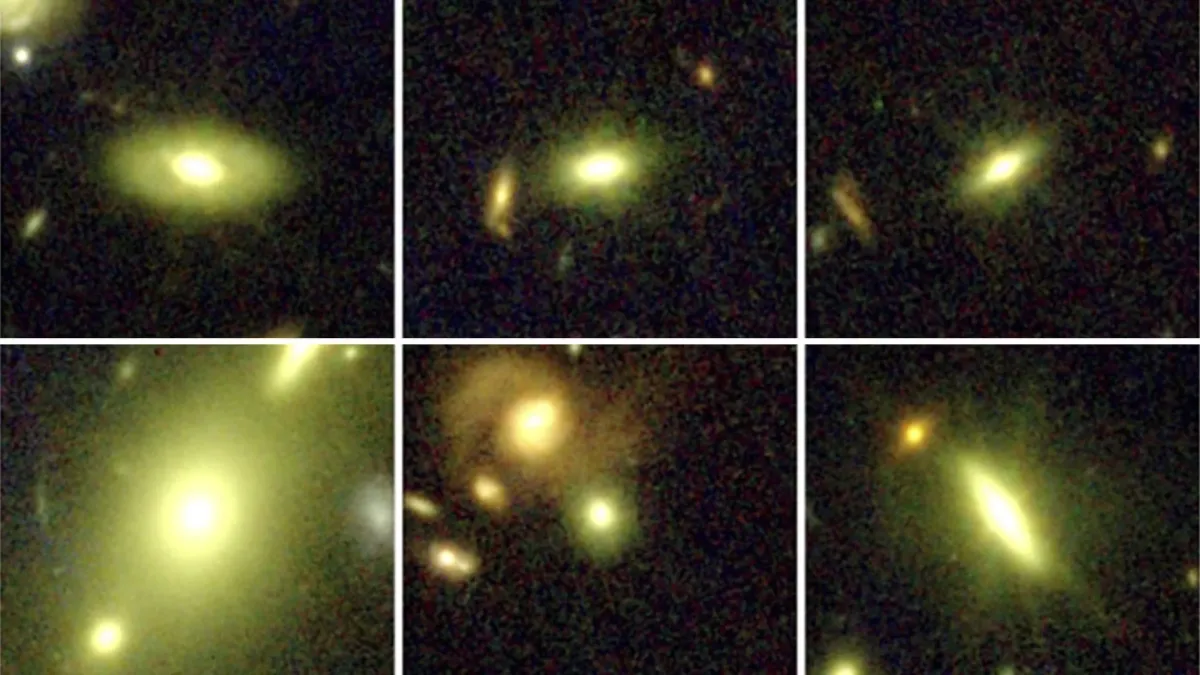
An international team, including researchers from Penn State, has identified a significant undercount of low-mass stars in ancient, mature galaxies that ceased star formation billions of years ago. By combining JWST's advanced observations with data from the Very Large Telescope, scientists were able to reliably distinguish between faint, low-mass stars and their brighter, larger counterparts in these distant galaxies for the first time.
"These galaxies are different," explained Joel Leja, an astronomy professor at Penn State and coauthor of the study published in Nature Astronomy. "They have three or four times more mass than we expected." This discovery challenges existing theories on how the very first galaxies formed and evolved.
Lead author Chloe Cheng of Leiden University likened the situation to a city skyline, where bright skyscrapers (large stars) obscure the view of numerous smaller buildings (low-mass stars). "Our models demonstrate that a far more numerous population of low-mass stars is concealed by those rare, bright stars," Cheng said, adding that this hidden mass drastically increases the estimated total mass of these galaxies.
The findings directly contradict the long-held assumption that stars form in roughly similar proportions across the universe. The study indicates that the most massive early galaxies contain a disproportionately larger share of low-mass stars compared to galaxies like our own Milky Way. One galaxy, formed less than 1.5 billion years after the Big Bang, could be up to four times more massive than initial calculations showed.
This revelation could reshape our understanding of the early cosmos. The existence of unexpectedly massive and mature galaxies shortly after the Big Bang has already perplexed astronomers. If these early galaxies were indeed significantly more massive due to a greater abundance of small stars, current models of galaxy formation will need substantial revisions to explain how such vast numbers of stars could have appeared so early in cosmic history.
Furthermore, the discovery has broader implications, potentially suggesting a higher number of planets formed in the early universe, as many planets orbit low-mass stars. The research team plans to use similar techniques to study even earlier galaxies, pushing closer to the dawn of cosmic star and galaxy formation.