Mounting evidence indicates continued Iranian support for the Houthi militia, despite the group's efforts to portray its military capabilities as domestically developed. While the militia promotes its missile and drone arsenal as indigenous products, documented findings reveal a persistent flow of Iranian technology, components, and expertise, enhancing the group's capacity for sophisticated attacks within Yemen and on Red Sea shipping lanes.
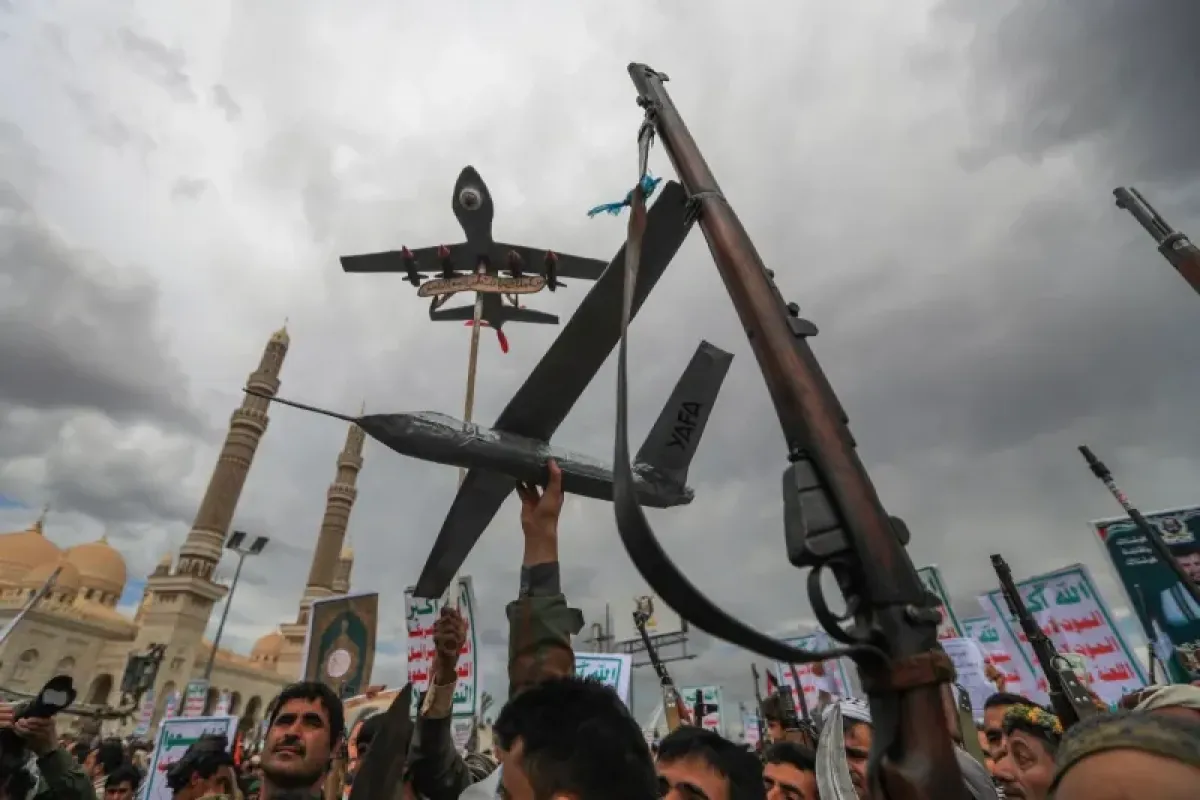
Analysis by the specialized platform Defense Line, examining footage released by the Houthis, revealed striking similarities between the group's attack drones and Iranian models operated by the Revolutionary Guard. The Houthis are reportedly using multi-rotor drones, designated "Regum" by the group, capable of carrying various bomb loads. These drones bear resemblance to the Iranian "Homa-4" multi-rotor drones and models displayed in Iranian military parades, including the "Arbaeen" model unveiled by the Revolutionary Guard in February 2025. The concern is not merely aesthetic resemblance but the evolving nature of these weapons, which are becoming advanced, low-cost, and repeatedly deployable attack platforms.
Further direct evidence emerged when the National Resistance announced that technical examinations of missile debris from recent Houthi attacks on the port of Mocha and civilian areas on the west coast identified them as the Iranian Fatih-110 model. A spokesperson for the National Resistance stated that these examinations provide tangible proof of Tehran's ongoing arms supply to the Houthis, dismissing it as more than mere political accusation. However, independent sources, including South24 Center, have noted that independent technical verification of these findings and the missile debris is still required. Conversely, a Yemeni military official speaking to Arab News confirmed the Houthi use of Iranian missiles in their latest attacks on Mocha, suggesting this contradicts the group's claims of local manufacturing.
A recent report by Conflict Armament Research (CAR) provides a broader perspective on the Houthi arsenal and its supply chains. The center documented over 800 components for missiles and drones seized in Red Sea interdictions during 2024 and 2025, finding evidence of continued Iranian-origin materials reaching the Houthis. These components were linked to at least 12 Iranian weapon systems, including anti-ship, surface-to-air, and ballistic missiles. Significantly, a substantial portion of these identified components were manufactured after 2020, with a notable percentage dating from 2023 and 2024, undermining the narrative that the Houthi inventory consists solely of old stockpiles seized from the Yemeni army. CAR's findings also suggest that weapons are sometimes supplied as separate, disguised components for assembly within Houthi-controlled territories, a tactic that complicates interception efforts and allows the group to leverage complex international supply networks.
While Iranian links are evident, the Houthi supply network is not exclusively Iranian. CAR reported that only 5% of the documented components could be directly attributed to Iranian production; the remaining components were linked to 16 other countries and regions, revealing the group's reliance on a wider global market for dual-use components. This complexity does not negate Iran's role but rather highlights its sophisticated approach, which can involve providing designs, technologies, sensitive components, and expertise for advanced systems to be assembled domestically. This external support system, composed of commercial or military components, programs, and expertise, forms a more flexible supply chain than fully assembled weapons.
The proliferation of these military capabilities poses a direct threat to international navigation beyond the context of the Yemeni conflict. Anti-ship missiles, drones, and unmanned maritime systems empower the Houthis to target commercial vessels, ports, and coastal infrastructure, transforming Yemen's coastlines and the Bab al-Mandeb strait into a theater for a regional conflict. CAR's report confirms that the documented components are associated with a wide array of advanced systems, including anti-ship, ballistic, and unmanned systems, reflecting the expanding and diversifying military capabilities of the group. This evolution, moving from older Soviet-era weaponry to more modern and diverse systems, is difficult to attribute solely to the seizure of Yemeni army stockpiles, strongly suggesting involvement in a cross-border arms supply network.
The continuing flow of these military capabilities, despite international sanctions and arms embargoes, raises questions about the effectiveness of international enforcement mechanisms and arms smuggling prevention. Specialized international reports detail not only old Iranian arms but also modern components and complex supply chains utilizing dual-use commercial materials. The ongoing interception and documentation of components, even after some have reached the Houthis, indicate that a strategy of isolated seizures is insufficient. Addressing the core issue requires dismantling supply and financing networks, tracing the pathways of technology and dual-use components, and pursuing intermediaries involved in these operations. The available evidence presents a picture more complex than the Houthi narrative of self-sufficient local production; the group possesses growing domestic assembly and development capabilities, but these are augmented by an external network directly linked to Iran. As Yemen bears the brunt of this development through attacks on its cities and ports and threats to maritime security, the Houthi arsenal transforms from an instrument of internal conflict into a platform for regional influence, making continued Iranian support a matter that transcends the internal conflict to impact Yemen's security and international maritime corridors.