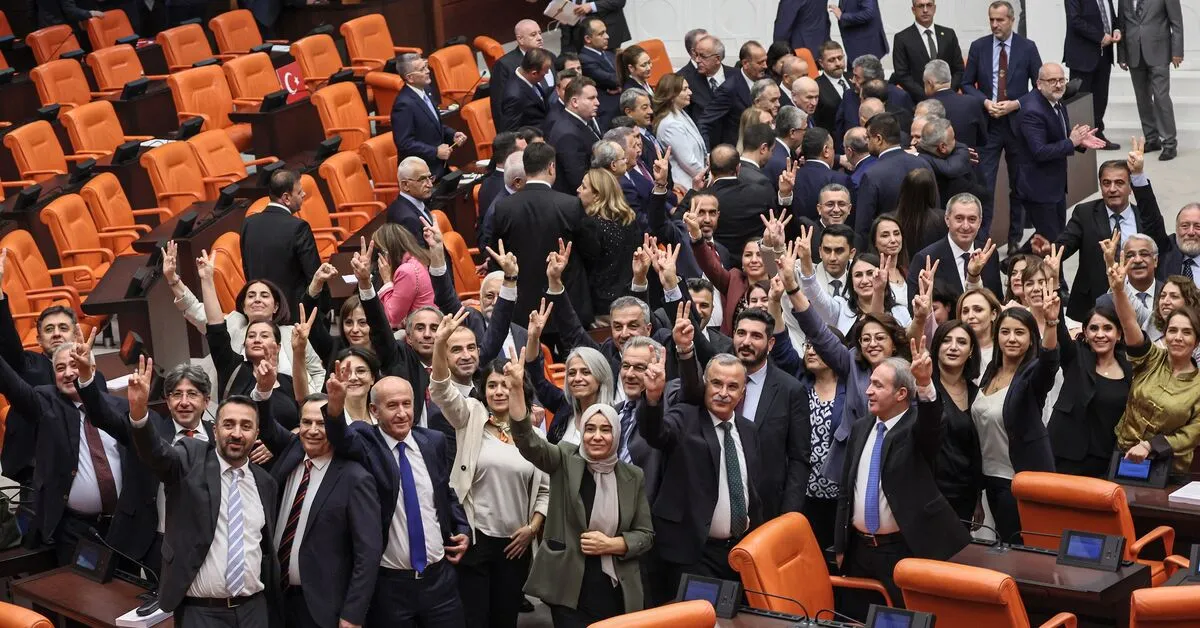
Turkey has officially entered the implementation phase of its peace process with the Kurdistan Workers Party (PKK), establishing working groups to oversee the disarmament of the militant group and address subsequent legal and civil measures.
The Turkish body responsible for monitoring the peace process convened its inaugural meeting on Monday. This development follows the PKK's announcement in May 2025 of its intention to disband, a commitment made as part of ongoing peace talks initiated by the Turkish government in 2024. The PKK has been engaged in an armed insurgency since 1984, advocating for Kurdish self-rule within Turkey.
The meeting, presided over by Vice President Cevdet Yilmaz and attended by high-ranking officials including the Foreign Minister, Defense Minister, and intelligence chief, resulted in the formation of four specialized working groups. These groups are tasked with managing various aspects of the implementation, which the government has termed "Terror-Free Turkey." This initiative marks a significant administrative step forward under a recently enacted framework law designed to conclude Europe's protracted armed conflict.
PKK leader Abdullah Ocalan, currently imprisoned since 1999, conveyed through a statement shared by the pro-Kurdish DEM Party that the process is advancing decisively and has reached a critical juncture. Ocalan's call in February for the PKK to disband and disarm preceded the group's May 2025 dissolution announcement. The DEM Party, Turkey's third-largest political entity, has also served as a conduit between the government and Ocalan.
The four working groups will focus on legal matters, progress monitoring, social reintegration, and disarmament. The recently approved legislation, which garnered substantial cross-party support, introduces a conditional amnesty for individuals involved with the PKK. Sentences for those convicted would be suspended, and ongoing cases put on hold for five to ten years, provided no further terrorism-related offenses are committed. However, the law excludes individuals convicted of intentional killings and those serving life sentences without parole for offenses predating 2005.
The efficacy of these amnesty measures is contingent upon the complete cessation of activities and dissolution of the PKK and its affiliated organizations, along with the surrender of all weaponry. Turkish security institutions must formally verify these conditions. The verification report will be submitted to the National Security Council for confirmation, after which individuals affected by the law will have a six-month period to apply for amnesty.
The immediate challenge lies in the Turkish authorities' verification of the PKK's complete dissolution and disarmament. The verification process is expected to conclude within two months, with the National Security Council anticipated to release its findings in October. The disarmament and monitoring working groups will lead this verification, while legal and social integration groups will address subsequent measures. The PKK has indicated that the current legislation is merely an initial step, calling for broader democratic reforms, including provisions for former militants to engage in democratic politics, enhanced protections for Kurdish identity and language rights, and Ocalan's release.