Forty years after a professor reportedly described the Immigration and Naturalization Service as the "Iron Ass" federal government, a new exhibition highlights the persistent and often contradictory nature of U.S. immigration policy, characterized by a historical cycle of enticement and expulsion of foreign workers.
The exhibition, titled "Help Wanted/Leave Now!" at the California Museum in Sacramento, explores the "revolving door" of programs and practices that have alternately welcomed and expelled workers, both legal and undocumented. California, with its long history of immigration, has consistently been at the center of this dynamic, reflecting national policies that fluctuate based on economic conditions and political expediency.
Curator Sean Mainwaring notes that the United States has historically recruited foreign workers who then establish roots, only to be expelled when economic downturns or political considerations arise. This pattern is exemplified by the experiences of various immigrant groups, from Chinese laborers during the Gold Rush to the Latino population along the U.S.-Mexico border, whose presence underscores the complex historical, cultural, and economic ties that transcend political boundaries.
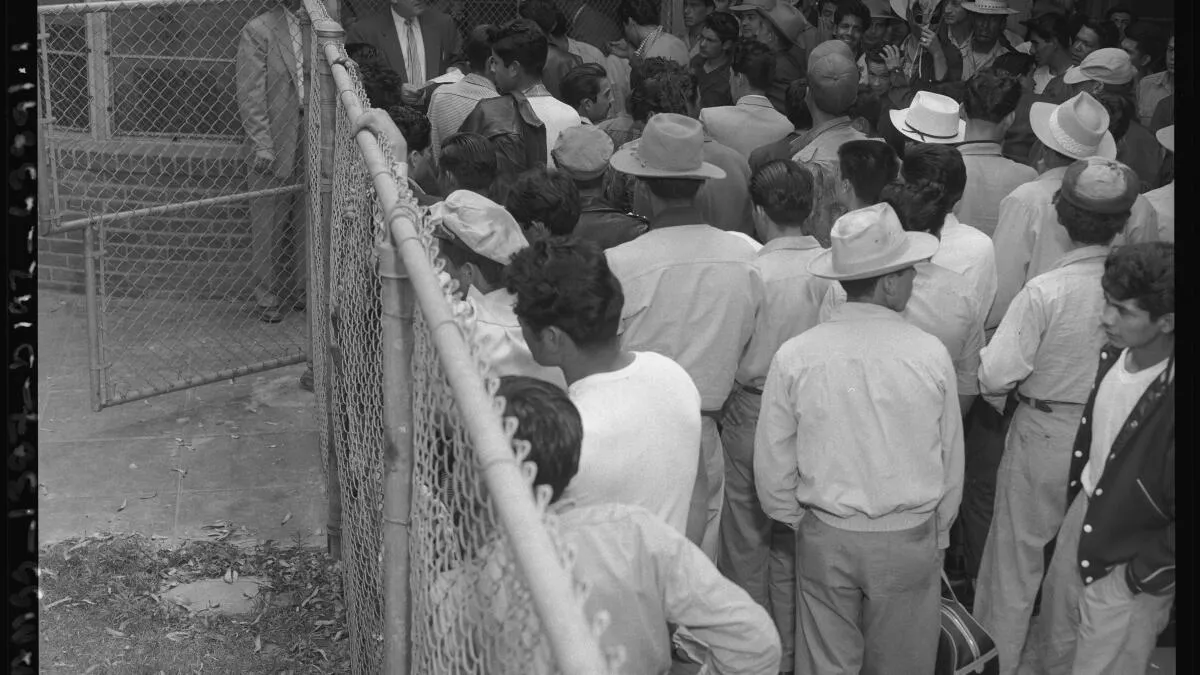
The article details various historical programs and operations that illustrate this cyclical policy. The Bracero Program (1942-1964) brought millions of Mexican workers to the U.S. to fill labor shortages, particularly in agriculture, while simultaneously, operations like "Operation Wetback" (1953-1954) aimed to deport undocumented immigrants, often indiscriminately. These programs reveal a pattern where foreign labor is sought during times of need and then targeted for removal when deemed politically or economically inconvenient.
The enduring debate over undocumented immigrants often centers on whether they take jobs from American citizens or perform roles that Americans are unwilling to do. Historical evidence, including reports from the Kansas City Federal Reserve, suggests that the U.S.-born labor supply has historically been insufficient for agricultural jobs at prevailing wages. Furthermore, the cost of legal immigration programs like H-2A can be higher than employing undocumented workers. This economic reality, coupled with shifting political climates, has perpetuated the cycle of recruitment and expulsion.
Even the language used to describe immigrants has a long, often derogatory, history. Terms like "wetback," which originated from the act of crossing the Rio Grande, became a widespread slur. Recent court records have revealed the continued use of derogatory terms by ICE agents, echoing the harsh rhetoric and practices seen in past operations. The exhibition draws parallels between historical deportations, such as the Mexican Repatriation during the Great Depression and "Operation Wetback," and contemporary immigration enforcement actions.
The article concludes by reflecting on the human cost of these policies, referencing Woody Guthrie's song "Deportees" and the numerous deaths that have occurred during deportations and in ICE custody. The exhibition aims to illuminate this complex and often painful history, demonstrating how the U.S. has, for centuries, oscillated between needing and rejecting its foreign-born workforce.