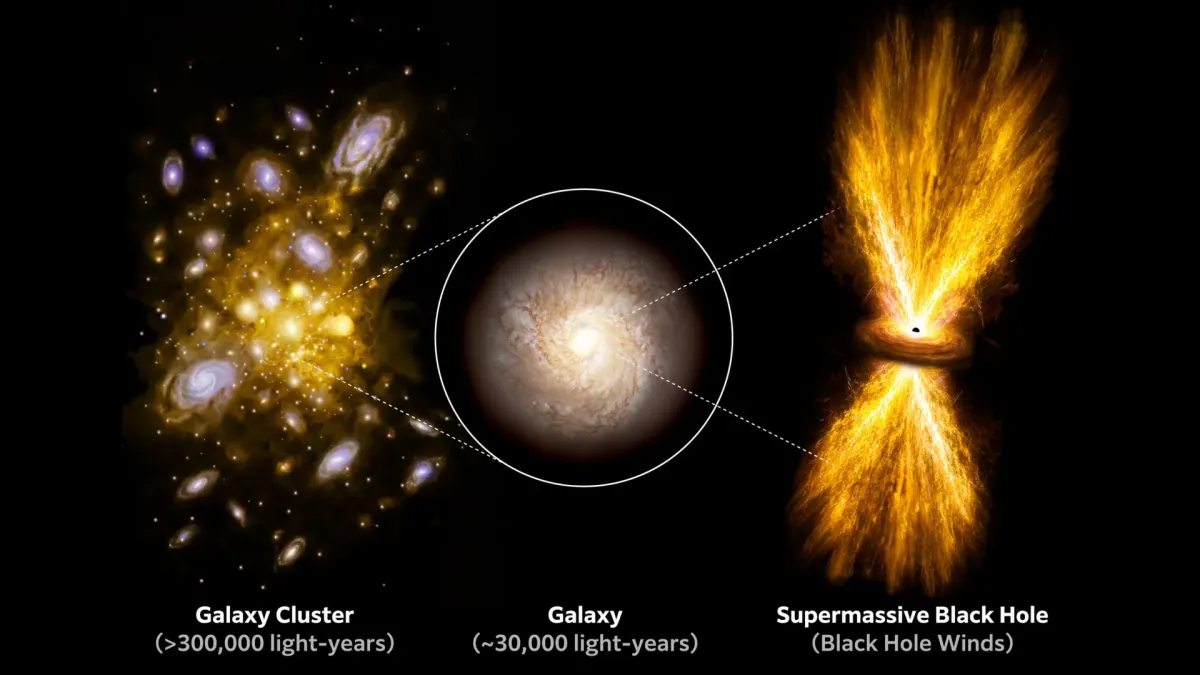
Supermassive black holes are way more influential than scientists initially believed, with new research revealing their winds can blast energy across an astonishing 300,000 light-years, far beyond their host galaxies. The energy packed into these winds is a staggering 100 times greater than previous estimates, showcasing the immense scale of black hole influence.
"Black holes are largely known for sucking matter in, but they also eject gas in the form of powerful winds," explains Satoshi Yamada, Assistant Professor at Tohoku University's Frontier Institute for Interdisciplinary Sciences (FRIS). "These winds were thought to be contained within the galaxy, but our study revealed that the force is immensely more powerful than previously understood."
Using the XRISM X-ray astronomy satellite, Yamada and his team focused on the quasar H1821+643, located about 3.4 billion light-years away in the constellation Draco. Quasars, powered by actively feeding supermassive black holes, are incredibly bright and visible across vast cosmic distances. The black hole at H1821+643, nestled in a galaxy cluster, stirs up surrounding hot gas that emits X-rays. By analyzing iron ion emission lines, researchers could track the gas's movement.
XRISM's precise measurements showed that the super-hot gas around the black hole isn't just sitting there; it's violently turbulent and spreads out across a huge area. This turbulent gas flow extends over 300,000 light-years from the host galaxy. Even more mind-blowing, the energy within this turbulence was about 100 times higher than previously calculated – comparable to the energy released by billions of supernova explosions.
"For the first time, we have shown that black holes influence the broader cosmic environment through a shock wave of astonishing power," adds Yamada. "Black holes are key drivers of gas flows and motion in space, transporting vast amounts of energy to different regions of the cosmos."
These findings suggest that supermassive black holes play a much bigger role in the universe than just consuming matter. They actively shape their cosmic neighborhoods by ejecting energy and gas, potentially influencing the evolution of galaxies and galaxy clusters. The study, published in Nature Astronomy, opens the door for future observations to further explore how black holes impact the cosmos.