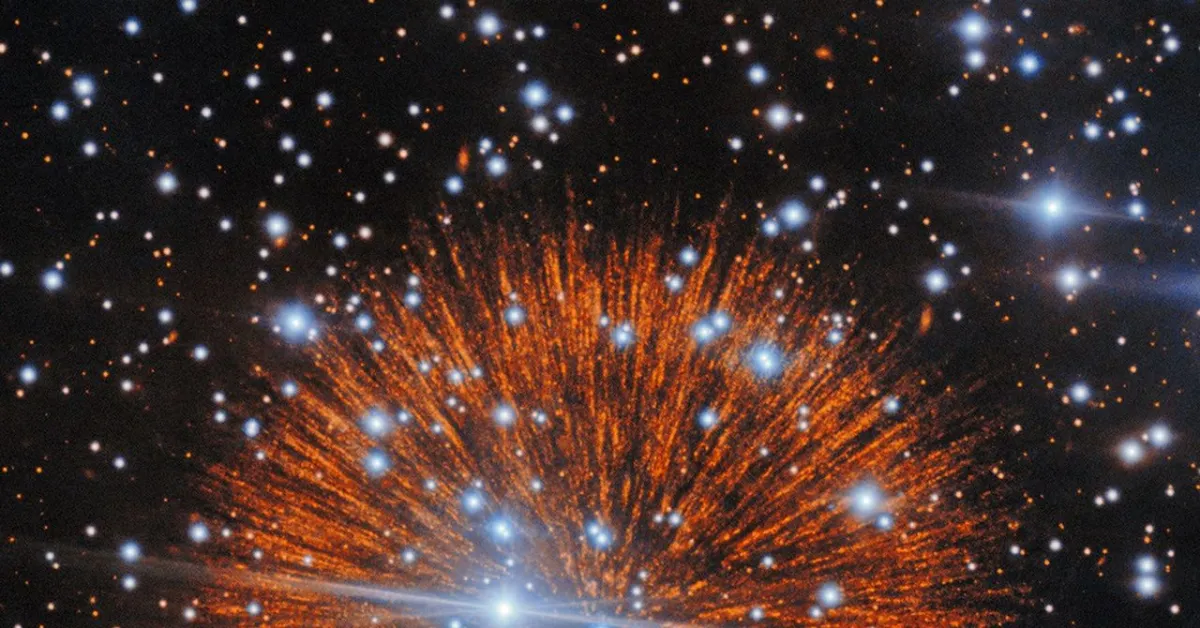
Astronomers have captured the most detailed image yet of the Pa 30 nebula, the remnants of a supernova first spotted by humans nearly a thousand years ago. This new, ultra-high-definition view unveils intricate structures previously hidden from view.
Past glimpses of the supernova's aftermath showed a spherical cloud of long, stringy matter resembling fireworks or a dandelion. However, using the Gemini North telescope in Hawaii, researchers have now revealed about ten times more detail, showing that these filaments aren't continuous strands. Instead, they appear like beads on a string, composed of uniformly sized, pearl-like knots of gas.
These "cosmic pearls" are mind-bogglingly massive, with each knot measuring roughly four light-days across. "The planetary region of our solar system could fit in each knot about 10 times with room to spare," explained Ilaria Caiazzo, a study coauthor, noting the striking uniformity. "We are excited to try to model them."
While it's believed these knots are concentrations of material blasted out during the explosion, their extreme regularity is puzzling. Astronomers expected more chaotic clumps after a supernova, but these knots are similar in size and aligned along the filaments, offering a new clue into stellar death.
Adding to its mystery, the central star of the Pa 30 nebula isn't completely gone. It's considered a "zombie star"—a rare survivor of a supernova that usually obliterates a star. Understanding Pa 30's unique structure could help scientists unravel how these stellar explosions happen and how some stars defy death.
The connection between this nebula and historical records is particularly cool. Pa 30 matches accounts from Chinese and Japanese astronomers in 1181 who documented a bright new star visible for months. They were witnessing a colossal stellar explosion, and centuries later, scientists linked that event to the birth of Pa 30.