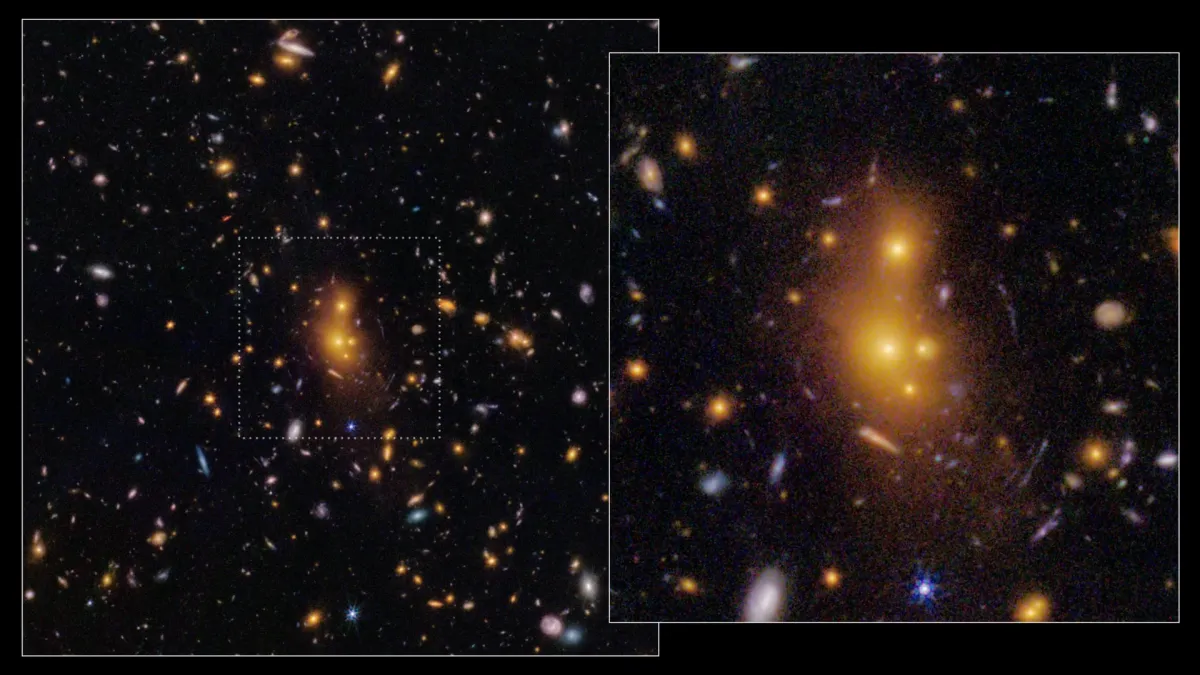
NASA's James Webb Space Telescope has uncovered a massive galaxy cluster, XLSSC 122, dating back to when the universe was just starting to build huge structures. This ancient cluster is baffling scientists because it's way more developed and densely packed than current theories predict for that early cosmic era.
Located about 10.4 billion light-years away, XLSSC 122 is the most distant galaxy cluster found to exhibit strong gravitational lensing. This phenomenon occurs when the cluster's immense gravity bends and magnifies light from galaxies behind it. The discovery, presented at a recent American Astronomical Society meeting, was made possible by JWST's incredible imaging capabilities, allowing astronomers to precisely measure the cluster's mass and structure.
"When we got those first images back from JWST, we said, 'wow, look at this, there's strong lensing coming from this cluster!'" said Kyle Finner, a lead researcher on the project. "XLSSC 122 has now set the record for the most distant galaxy cluster displaying strong lensing, which is a valuable tool for astronomers."
The cluster formed during "cosmic noon," a period about 10 billion years ago when star formation was at its peak. While galaxy clusters were actively merging and growing then, XLSSC 122's highly concentrated mass at its center doesn't align with standard cosmological models, which suggest a more gradual buildup of such structures.
JWST's observations, combined with earlier data from XMM-Newton and Hubble, have also revealed the cluster's significant dark matter content. Gravitational lensing is a key method for mapping this invisible substance, which makes up the majority of the universe's mass and holds galaxies together. The new findings suggest that dark matter might have played a more significant role in accelerating structure formation in the early universe than previously thought.
Further analysis using weak gravitational lensing and by studying faint intracluster light – scattered starlight between galaxies – indicates that XLSSC 122 is actively merging. The distribution of this scattered light remarkably mirrors the inferred dark matter distribution, hinting that intracluster light could become a new way to map dark matter in the early universe. Researchers plan to search for more ancient clusters like XLSSC 122 to see if this cluster's surprising maturity is a common feature of the early cosmos, potentially requiring a rethink of fundamental cosmological theories.