
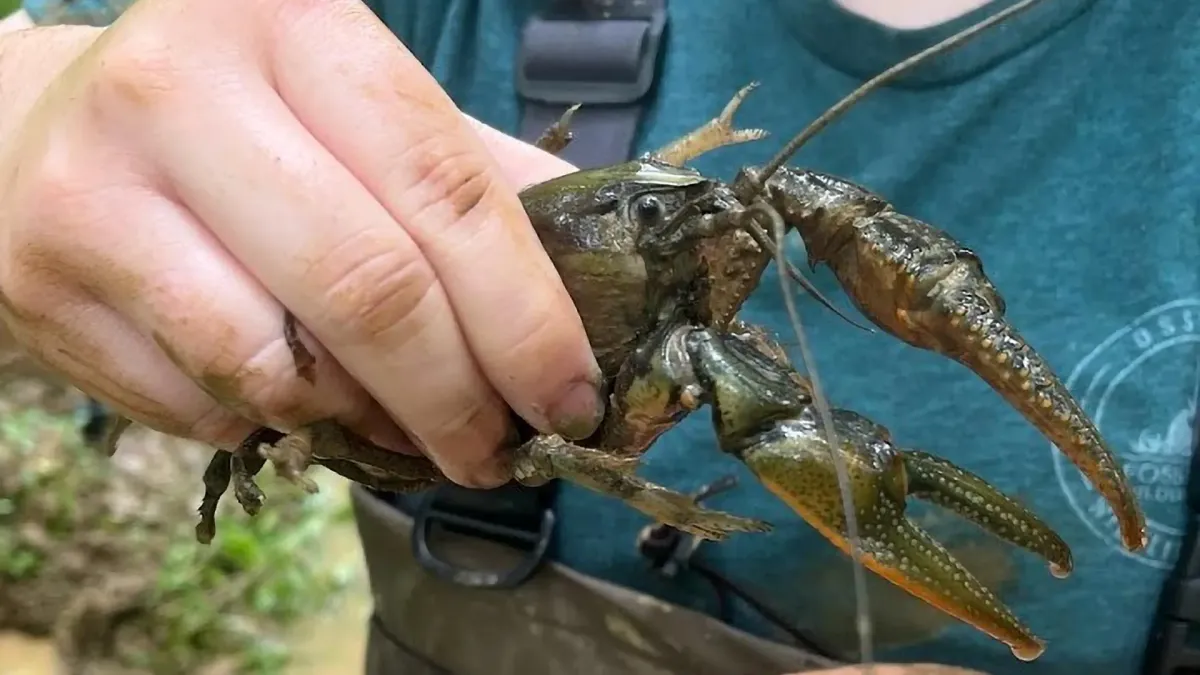
A massive crayfish, affectionately nicknamed "Crawzilla," has triggered a scientific investigation into the potential biological limits of North American crayfish size. The surprising discovery began when Caitlin Bloomer, a teaching assistant professor at the University of Illinois Urbana-Champaign, found an enormous crawdad during a survey in Kentucky, believing it to be the largest ever documented.
Bloomer's initial excitement turned into a nationwide quest after a colleague playfully challenged her claim, suggesting he'd caught bigger specimens. This friendly rivalry spurred Bloomer to contact biologists and museum curators across the country, prompting a thorough examination of preserved crayfish collections. Using precise calipers, researchers analyzed 20 exceptionally large crayfish from 18 different species, publishing their findings in the journal Ecology.
While Bloomer's "Crawzilla" didn't secure the top spot, it did make the top 20 list and uniquely stood out as the only burrowing crayfish identified. The actual record-holder for the largest North American crayfish was a Tennessee bottlebrush crayfish, preserved at West Liberty University in West Virginia. This impressive specimen, measuring 86.6 millimeters (about 3.4 inches) excluding its tail, claws, and antennae, was collected in 2011.
Beyond settling the friendly competition, the study unearthed a significant scientific question: why do North American crayfish seem to reach a consistent growth ceiling of around 80 millimeters in body length? This contrasts sharply with much larger species found in other parts of the world, like the Tasmanian giant freshwater crayfish. Researchers explored environmental factors such as latitude, oxygen levels, and habitat type, but found no clear correlation with maximum body size.
The findings suggest that the size limitation might be rooted in the crayfish's own biology, potentially due to their exoskeletons or muscle anatomy. This hypothesis opens a new avenue of research into the physiological constraints that shape crayfish growth. The discovery highlights how much basic information about even well-known species like crayfish remains to be uncovered, emphasizing the crucial role of museum collections in advancing scientific understanding.