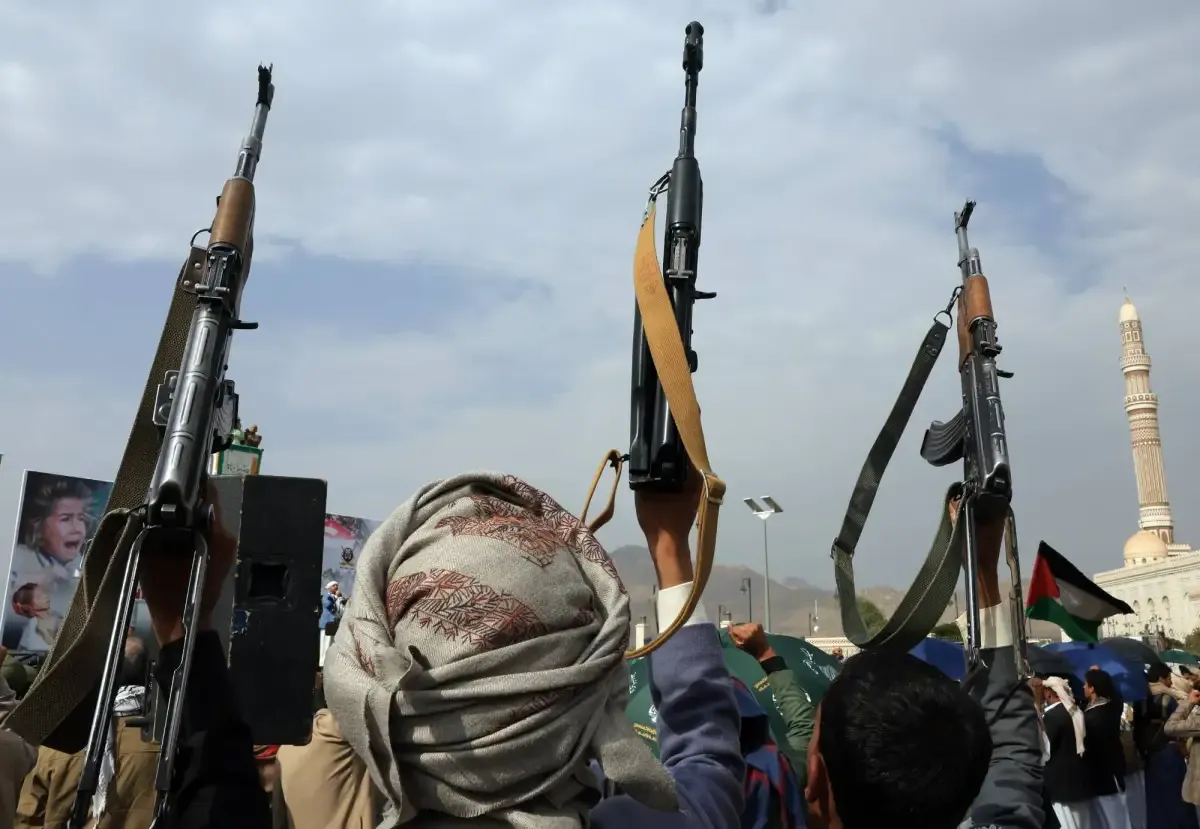
A recent intelligence investigation indicates that the Iran-backed Houthi militia has advanced its long-range cruise missile capabilities, with evidence suggesting the acquisition of foreign technology, components, and expertise. This development enhances the group's ability to target strategic installations far from the front lines in Yemen.
The investigation, published by Sheba Intelligence, highlights military activities observed in July, including the deployment of cruise missile launch platforms in Saada province, near the Saudi border. Concurrently, missile specialists and technical support teams were reportedly moved to border areas, signaling preparations beyond mere weapon stockpiling to operational readiness.
These findings are particularly relevant in light of recent attacks targeting King Khalid International Airport in Riyadh. The Saudi-led coalition reported 20 attacks between October 1st and 11th, comprising drones, ballistic missiles, cruise missiles, and unspecified projectiles. The coalition stated these included ten drones, four ballistic missiles, four cruise missiles, and two unidentified projectiles, resulting in casualties, injuries, and damage to airport facilities, including a fire in Terminal 4.
The analysis suggests that some Houthi missile capabilities may exceed a range of 1,600 kilometers, based on technical assessments and comparisons with Iranian systems and intercepted maritime shipments. However, the investigation differentiates between technical estimates and independently verified capabilities, emphasizing that public displays of missile systems do not necessarily equate to full operational capacity.
The report posits two main scenarios for the Houthi's evolving missile program: either the direct acquisition of complete cruise missiles through international smuggling networks or the enhancement of existing missiles with foreign components and technical expertise. Evidence supporting the first scenario includes intercepted maritime arms shipments, while the second focuses on the Houthi's capacity for modifying and upgrading previous weaponry. International investigations cited in the report suggest the Houthi missile program is a hybrid, involving foreign components, supply networks, and domestic assembly and upgrades, with Iran identified as a primary source of military and technical support.
The investigation also raises the possibility of foreign experts from Russia, China, and India contributing to certain missile systems, based on technical analysis of propulsion, navigation, and guidance systems. However, the report clarifies that this remains a hypothesis without direct evidence. Nevertheless, evidence of foreign components in intercepted arms shipments and analyses of missile debris, previously linked by UN expert panels to attacks in Saudi Arabia, the UAE, and Yemen, provide a basis for tracing the Houthi arsenal's development and supply sources.
The Houthi missile advancements are situated within a broader network of military supplies, including ready-made weapons, dual-use commercial components, intermediaries, and smuggling operations. This complex supply chain, potentially involving routes through Iran, Somalia, and Djibouti, makes it challenging to disrupt, as components may arrive separately and be assembled or modified within Yemen. The sustainability of these operations raises questions about the group's remaining missile inventory, its capacity for replenishment, and the access to spare parts and technologies.
The implications of these developments extend beyond Saudi Arabia, with Houthi missile activities observed in Hodeidah province and along the western coast, near key maritime routes like the Red Sea and Bab el-Mandeb strait. This indicates a potential for attacks on maritime infrastructure and broader regional security. Cruise missiles, differing from ballistic missiles in flight paths and propulsion systems, can be harder to detect if flying at lower altitudes, especially when used in conjunction with drones and other projectiles.
The investigation underscores that identifying the sources of Houthi weaponry is crucial. If the advancements in cruise missile capabilities are confirmed, the threat extends beyond existing stockpiles to the group's capacity for modernization and replenishment through external supply chains that cannot be dismantled by military strikes alone. While analysis of missile debris from recent attacks is essential, mitigating the threat requires enhanced surveillance of smuggling networks, intermediaries, and dual-use components, along with international cooperation in tracking military technology transfers. Although some conclusions require independent verification, the evidence of foreign components and arms shipments presents a pressing security issue threatening civilian lives, critical infrastructure, and regional stability.