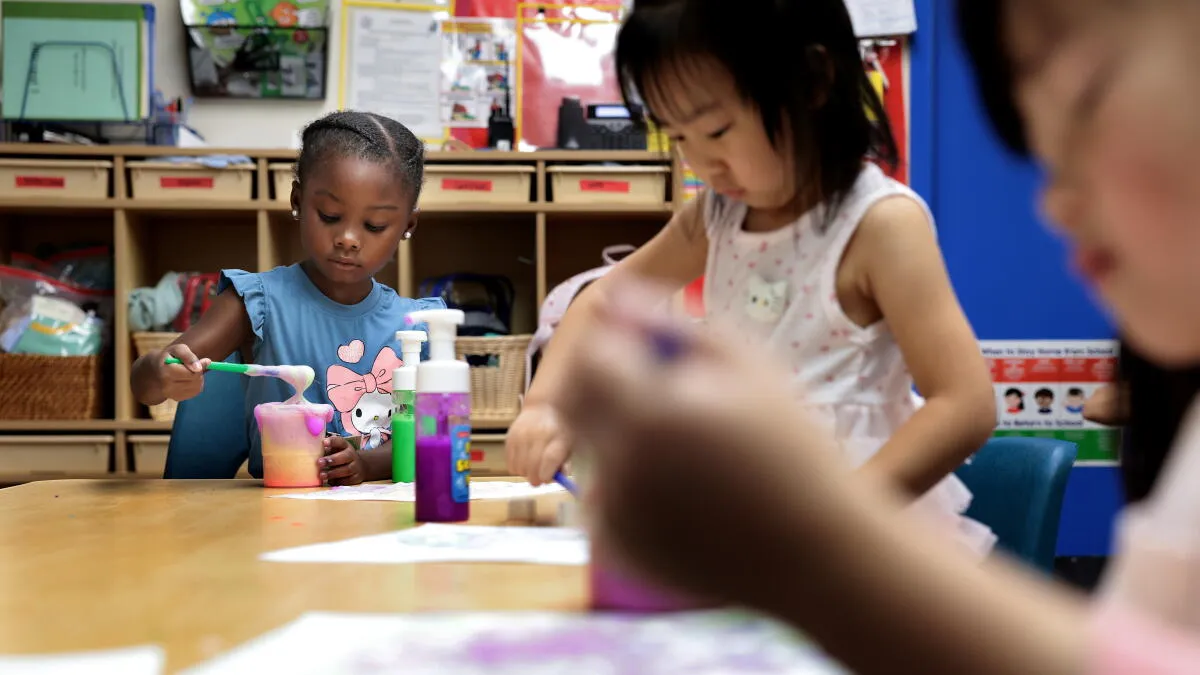
A comprehensive study on California's substantial investment in early education programs reveals significant, long-term academic benefits for children participating in transitional kindergarten (TK) and state-funded preschool. Children who attended these programs demonstrated academic achievements years later, scoring considerably higher in reading and mathematics by third and fourth grade compared to their peers who did not have access.
The research, conducted by UC Berkeley and commissioned by Stanford University, analyzed data from 1.6 million children who started kindergarten between 2011 and 2014. Findings indicate that children enrolled in California's initial transitional kindergarten programs, established by a 2010 law, performed 11 months ahead in reading and eight months ahead in math by third and fourth grade. This law expanded eligibility for state-funded preschool to more three-year-olds and allowed children with fall birthdays to attend a full year of school before kindergarten, known as transitional kindergarten.
The study highlights that these early educational interventions are particularly effective in narrowing achievement gaps between children from different socioeconomic backgrounds. For children from low-income families, TK alone contributed approximately seven additional months of learning in third-grade reading and math. The benefits were even more pronounced for low-income children whose parents spoke a language other than English, with significant gains observed in both fourth-grade math and reading when they attended both preschool and TK.
Educators on the ground corroborate these findings. Marylou Escobar, a kindergarten teacher with 41 years of experience, observes that students who have attended TK are better prepared for the classroom environment. They exhibit foundational skills such as following instructions, transitioning between activities, and independent work, allowing her to focus on more advanced learning. Conversely, students without this early exposure often require instruction in basic classroom conduct.
The study's co-author, Rucker Johnson, a professor of public policy at UC Berkeley, emphasizes that early investments serve as a catalyst for unlocking potential in children who might otherwise be limited by their circumstances. He likens this to discovering "lost Einsteins," suggesting that such programs provide opportunities for individuals to realize their full capabilities. The findings are particularly relevant as California continues to expand its free TK program to all four-year-olds, though enrollment rates have not yet met state projections.
As California navigates the expansion of its TK system, the focus shifts to maintaining program quality, including the recruitment of adequately trained educators. Researchers plan to track these students further to determine if their early academic advantages translate into improved high school graduation rates and college readiness, suggesting a potentially multiplicative effect of early educational investments.