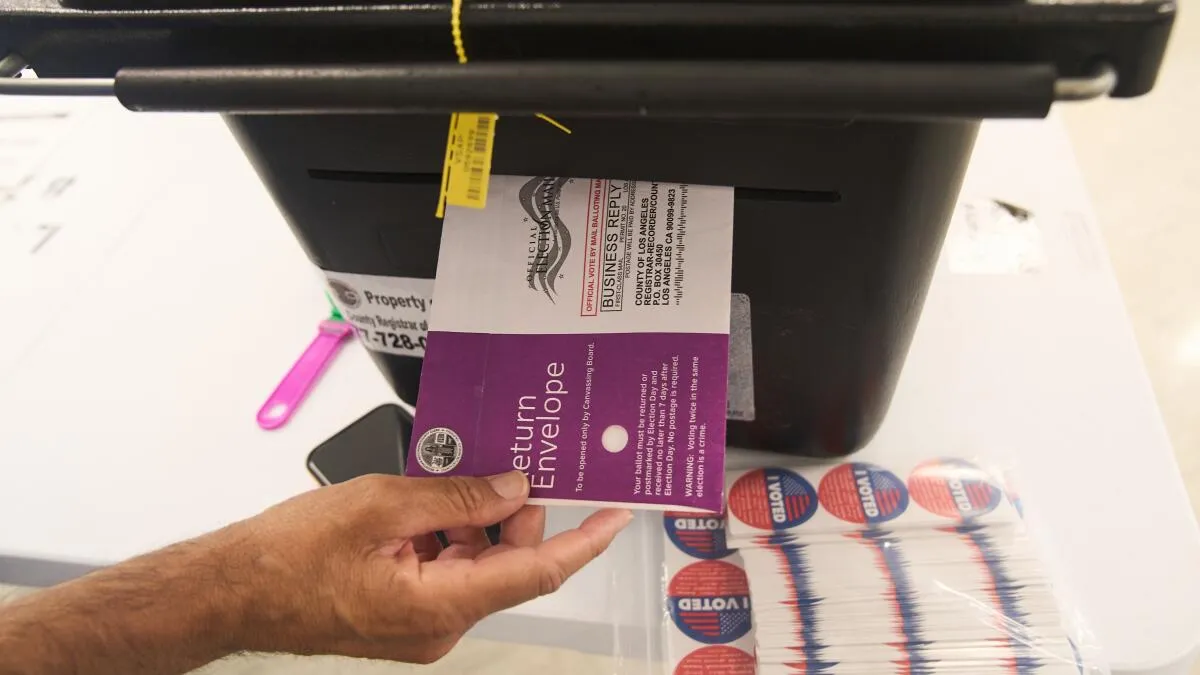
California is playing a significant role in a national trend toward fewer competitive congressional elections, with its recent redistricting process dramatically reducing the number of swing districts. Despite this shrinkage, a handful of critical races within the state are poised to be decisive in determining which party controls the U.S. House of Representatives.
The redistricting efforts undertaken in California and nine other states since 2024 have resulted in an unusually low number of truly competitive districts nationwide, narrowing the battle for control of the U.S. House to a few dozen races. In California, this has led to a paradox: a shrinking number of political battlegrounds alongside a core group of crucial contests. This outcome is largely attributed to Proposition 50, a voter-approved redistricting initiative spearheaded by Democrats, designed to counteract maps drawn by Republicans in other states.
Data from the nonpartisan Cook Political Report indicates only three California races are considered competitive, a sharp decrease from 12 in 2024 and nine in 2022. California was the primary driver of the nationwide decline in competitive seats, with six of the 14 U.S. House seats moving out of the swing-seat category in 2026 located in the state. "There’s no question that we’re seeing the consequence" of the state’s redistricting, leading to "fewer competitive districts," stated Michael Latner, a professor of political science at Cal Poly San Luis Obispo. However, he added that this does not diminish California's pivotal role in the Democratic effort to secure a House majority, as the new map has made some Democratic-held seats safer and created opportunities to flip up to five Republican-held seats.
The current electoral landscape, characterized by a fierce fight for the majority during President Trump's second term, sees Republicans facing voter concerns over the economy and foreign policy. Democrats are leveraging economic frustrations to build their campaigns. Thad Kousser, a political science professor at UC San Diego, noted that the increased number of safe seats positions California to have a greater impact on the election and in Congress afterward, expecting a substantial Democratic delegation from the state. This shift marks a return to the electoral map configuration of the 2000s in California, prior to new maps in 2010 and 2020 that introduced more battleground areas.
The significant reduction in California's competitive seats, driven by Proposition 50's partisan redistricting, was particularly pronounced because the prior 2020 map was relatively neutral, according to Cook senior editor David Wasserman. In contrast, states like Florida, Missouri, and Texas saw less extreme shifts as Republican-drawn maps replaced already partisan ones. Of the three seats targeted by Democrats via Proposition 50, two present challenges: the Central Valley seat held by Republican David Valadao, rated as the state's sole toss-up by Cook, and the San Diego area seat vacated by Republican Darrell Issa, where the redrawn district now slightly favors Democrats. Republicans are focusing on the Central Valley seat held by Democrat Adam Gray, which the new map makes slightly more favorable to Democrats but remains a challenge for both parties.
Both major parties view California's three most competitive races as critical to their strategies, with substantial resources being allocated to these contests and a few additional races. "We’re not backing off a single seat in California," affirmed Christian Martinez, spokesperson for the National Republican Congressional Committee, stating, "We’re on offense." This electoral environment is amplified by a nationwide trend of increasing polarization, with only 18 of 435 House districts currently rated as toss-ups by Cook Political Report. Experts suggest this erosion of electoral competition could be detrimental to democracy, potentially diminishing voters' sense of influence and contributing to negative perceptions of the electoral system.