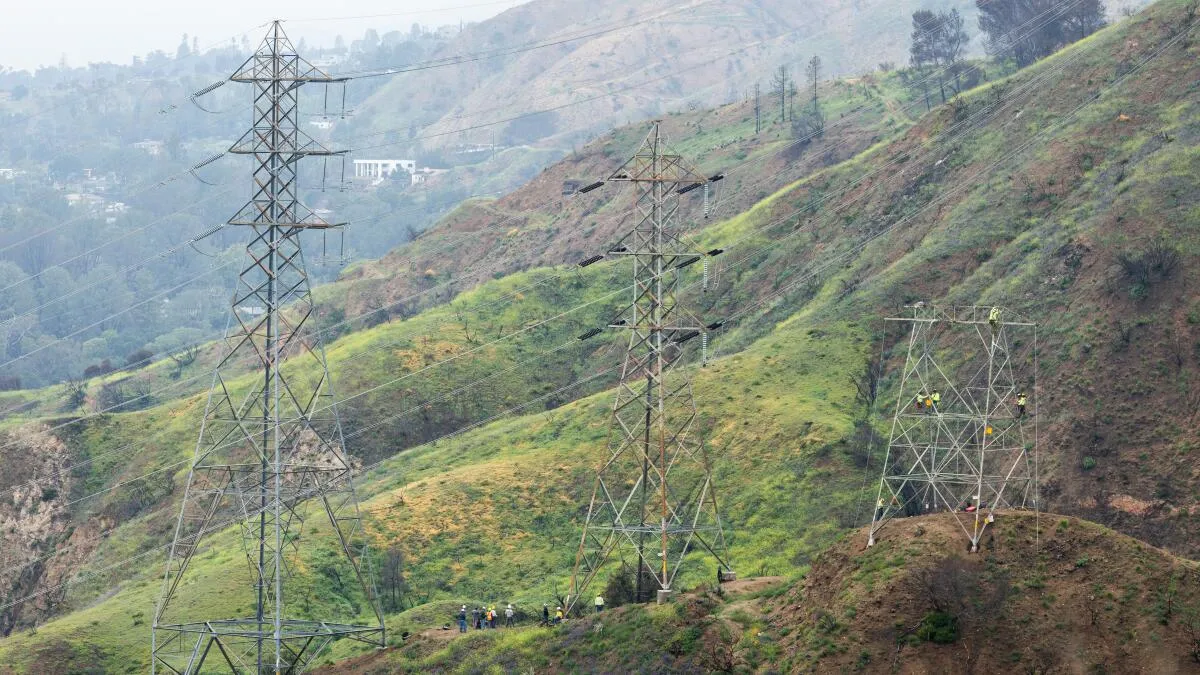
Newly revealed evidence from government investigators and court filings are raising renewed questions about Southern California Edison's assertion that it operated its electrical grid safely prior to the deadly Eaton fire. While many records related to the fire's cause remain sealed at the request of Edison and plaintiff attorneys, new details have emerged indicating that critical fire prevention equipment required repairs before the blaze and that vegetation beneath the tower where the fire ignited had not been trimmed for years.
Fire investigators cited eight violations in their report released on August 4, including three criminal code violations. These details were blacked out as the district attorney continues a separate investigation into the devastating fire. Edison spokeswoman Kathleen Dunleavy stated, "We don’t believe there is a basis for criminal liability and we will cooperate with any review." The report detailed that the fire, which resulted in 19 fatalities and the destruction of over 9,000 structures, was caused by electrical arcing on an out-of-service transmission line in Eaton Canyon, leading to hot metal fragments falling into dry vegetation.
Key takeaways from the investigation and recent court filings highlight that Edison did not shut off power to its Eaton Canyon transmission lines despite emergency conditions. Forecasters had predicted a "life-threatening" windstorm with gusts reaching up to 90 miles per hour, and Governor Gavin Newsom had declared a state of emergency due to another wildfire. Nevertheless, Edison maintained power to its high-voltage transmission lines. Dunleavy defended this decision, stating that the conditions did not meet the company's internal criteria for de-energizing the lines.
Further scrutiny reveals that safety equipment on the out-of-service line was damaged prior to the fire but remained unrepaired. This equipment was designed to safely ground any unexpected power surges. Court filings indicate that a component meant to be secured with four bolts was improperly attached with only one, allowing debris to accumulate and create a dangerous air pocket. Investigators observed similar "abnormalities" during a site tour with Edison representatives, with a lineman reportedly stating the issues were not new and had not been corrected from previous inspections.
Additionally, Edison reportedly failed to clear vegetation below the tower where the fire ignited, violating its own safety standards for "structure brushing." Despite knowing for decades that idle lines could reenergize and spark fires, Edison kept the century-old line in place. Edison has since sued Los Angeles County and other public entities, attributing the fire's destruction in part to their alleged failures in vegetation management and evacuation warnings.
The fight over accountability is ongoing, with the first jury trial on Edison's alleged negligence scheduled for January 25. State regulators will later assess whether the company acted "prudently." Under a 2019 law, Edison is presumed to have acted prudently if its wildfire prevention plan was approved by regulators, which it was just before the fire. This provision could lead to the state reimbursing Edison for billions in damages unless Sprague can prove negligence. Survivors' advocates argue this legislation strips utilities of financial incentives to prevent fires, calling it a "continuing pattern of catastrophic corporate failure."