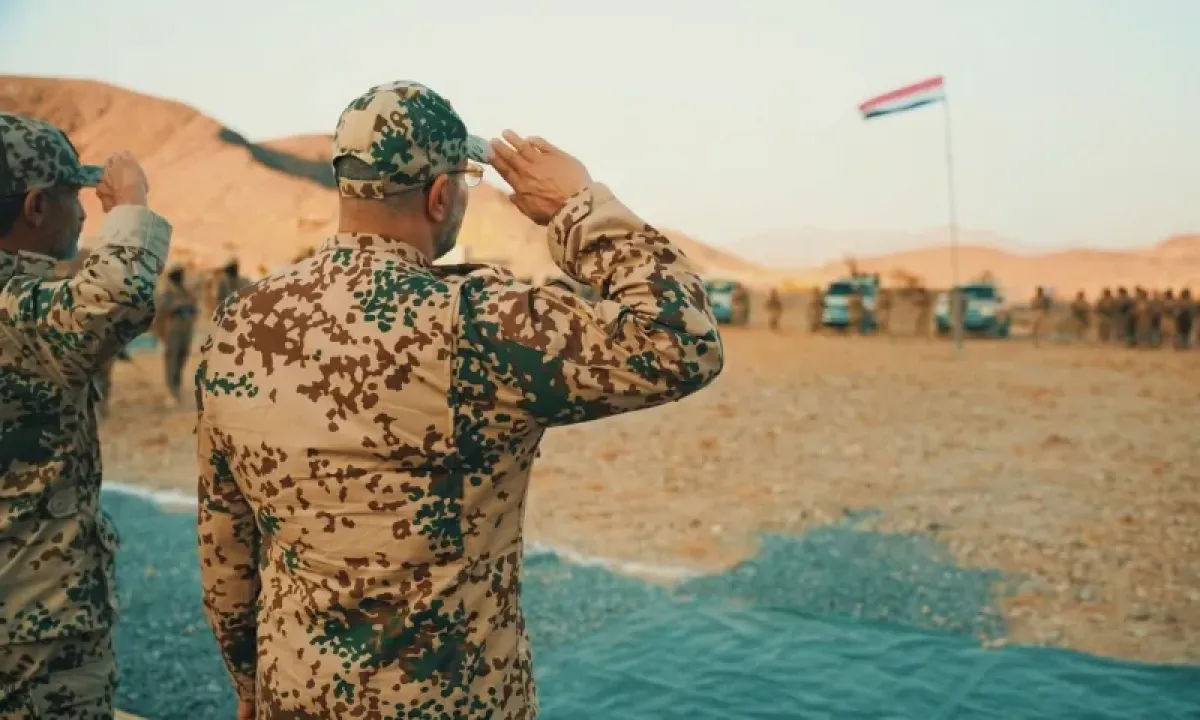
Tareq Saleh, a member of Yemen's Presidential Leadership Council and commander of the National Resistance, has intensified efforts to foster trust and unity across various fronts in the western coastal region. These initiatives aim to bolster a political and popular base for the ongoing struggle to restore the state.
Saleh's recent engagement in the liberated cities of the West Coast, which included visits to markets, streets, and direct interaction with citizens, alongside extensive meetings with local authorities, tribal leaders, and social figures, underscores a strategic approach. Beyond its immediate military implications, this mobilization signifies a broader political objective: demonstrating that the conflict in the West Coast is not solely a military endeavor but is deeply rooted in fostering solidarity with the local populace and consolidating unified official and popular stances against what is described as an Iranian agenda in Yemen.
These activities coincide with escalating Houthi provocations in the Red Sea and West Coast fronts, particularly targeting civilian infrastructure and ports. The port of Mocha and other liberated areas in the western coastal region face a dual challenge: safeguarding maritime navigation routes and maintaining vital commercial outlets upon which the local population depends.
The direct engagement with citizens in an environment strained by years of war is crucial for rebuilding confidence between the community and the military and political forces operating on the ground. The West Coast is strategically and economically significant due to its proximity to Bab el-Mandeb and the Red Sea, and it hosts the Mocha port, a critical gateway for liberated territories, including Taiz and the western coastal areas. Consequently, unifying political and popular efforts to protect these areas, ports, and maritime corridors transforms the conflict from a localized military confrontation into a wider national project involving local authorities, the community, and military and political factions.
During a meeting with local council members, executive office directors, tribal elders, and social figures in the districts of Mocha and Mozza, Saleh asserted that recent Houthi escalation is directed by Iran's Revolutionary Guard Corps. He accused the militia of targeting civilian vessels in the Red Sea and Bab el-Mandeb, including an Indian ship, with the aim of intensifying the blockade on Yemenis and attempting to shut down Mocha port, which he characterized as a vital maritime outlet for the liberated governorates. These accusations come at a time when Mocha continues to serve a critical commercial and humanitarian role for areas outside Houthi control, making any attack on the port have repercussions extending beyond the military sphere to the flow of goods, supplies, and the lives of the populace.
Saleh revealed that Houthi militias have targeted the West Coast with 56 ballistic missiles and 44 suicide drones. He stated that these attacks failed to achieve their military objectives, though they caused damage to civilian assets, ports, and service facilities, including Mocha port. These figures, if accurate, highlight the intensity of the escalation in the West Coast front and suggest a shift by the Houthis towards the extensive use of missiles and drones against targets that are not exclusively military.
Saleh interprets the high volume of attacks as a reflection of the Houthis' inability to engage in direct confrontation, viewing the targeting of civilian infrastructure as an act of reprisal after the failure of their plans and those of their allies to reach Bab el-Mandeb. Notably, Saleh's discourse focused on the developing military capabilities of anti-Houthi forces, particularly in drone technology and artillery. He indicated that newly acquired weapons and training have disrupted the calculations of the Houthis and the Iranian Revolutionary Guard Corps, adding that field fighters have inflicted losses on the militia and surprised them with locally developed military capabilities.
These communications suggest an effort to convey that anti-Houthi forces on the coast are moving beyond defensive postures to developing offensive capabilities for future stages of the conflict. Journalist Abdul Salam Al-Qaisi described Saleh's speech as a "war message," noting its emphasis on the battlefield and the restoration of the state, with no mention of peace, signaling a shift in the rhetoric of anti-Houthi factions towards a more decisive military stance.
Al-Qaisi also observed Saleh's lack of reliance on the international community and his critical remarks regarding the lack of genuine engagement with the United States. This suggests a growing sentiment among forces on the ground that the protection of maritime routes cannot depend solely on international actions, especially given the persistent Houthi attacks. Yemeni entities bordering the Red Sea are increasingly seen as responsible for shouldering a greater burden in confronting these threats. In this context, Saleh praised the role of the Yemeni Navy and Coast Guard in combating Iranian arms smuggling operations, stating that these forces are working to sever the Revolutionary Guard's supply lines to the Houthis, leading to increased scrutiny and pursuit of smuggling operations in the Red Sea and Bab el-Mandeb.
A significant political message from Saleh's discourse, as interpreted by Al-Qaisi, is the assertion that citizens in Houthi-controlled areas do not necessarily endorse the militia's agenda, and many supporters may be acting under duress. This message seeks to redefine the conflict not as a war between regions or social components, but as a confrontation with an armed group imposing its agenda by force. This approach aims to broaden the political and popular struggle into Houthi-controlled territories by addressing the populace as part of the Yemeni society, rather than as adversaries.
The broader implication of the National Resistance leadership's actions and Saleh's address is the linkage of the West Coast battle to a larger political and military objective than merely protecting Mocha or deterring Houthi attacks. Al-Qaisi suggests that Saleh frames the West Coast conflict not as a defensive engagement solely to protect Bab el-Mandeb, but as part of a wider campaign to reclaim Hodeidah, Sana'a, and state institutions. Thus, the West Coast is repositioned from a defensive front to a potential base for a long-term military and political project centered on unified local efforts, enhanced military capabilities, support for naval and coast guard forces, and mobilizing society behind the goal of state restoration. These developments occur at a juncture where conflict fronts face a choice between prolonged attrition or transitioning to a more organized phase uniting anti-Houthi forces politically, popularly, and militarily. The National Resistance leadership's engagement with the street and local communities in the West Coast signifies more than just field activity; it carries a clear political message: rebuilding the internal front in liberated areas and leveraging the rapprochement between leadership and society to fuel a broader national battle against the Houthis, ultimately leading to the restoration of state institutions.