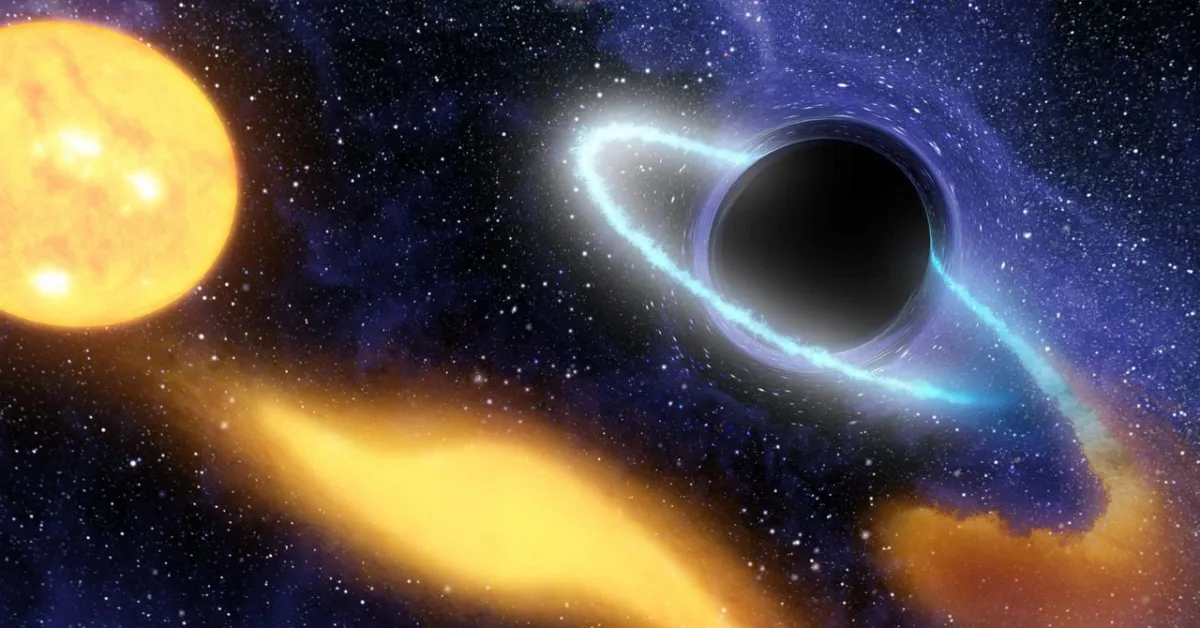
Astronomers have pinpointed the fastest star in our galaxy, S301, which whips around the supermassive black hole at the Milky Way's center, Sagittarius A*, at staggering speeds.
This star, S301, hits an incredible top speed of 25,000 kilometers per second (km/s), completing a full orbit in just 8.7 years. For perspective, our Sun moves at about 230 km/s around the galactic center. At its fastest, S301 is moving over 100 times faster than the Sun and reaches about 8% of the speed of light.
The secret to S301's incredible velocity is its close proximity to Sagittarius A*, the black hole with a mass equivalent to four million Suns. At its nearest point, the star passes Sagittarius A* at a distance comparable to that between Saturn and our Sun. The black hole's immense gravitational pull accelerates S301 dramatically, though the star follows an elongated orbit rather than falling in.
This elliptical orbit is also why the star's speed fluctuates so much – it's moving fastest when closest to the black hole and slower when farther away, much like some comets in our own solar system. Scientists theorize S301 likely didn't form in its current location but was once part of a binary pair that was ripped apart by Sagittarius A*'s tidal forces. S301 was then captured by the black hole's gravity, while its companion was likely flung out of the galaxy.
The close orbit of S301 offers a unique opportunity for scientists. Within the next decade, they hope to determine the spin of Sagittarius A*, a crucial property for understanding black holes alongside mass. While there are hints Sagittarius A* is spinning, measuring its rotation precisely is challenging. According to Einstein's theory of general relativity, a spinning black hole should drag spacetime around it, subtly altering S301's orbit. Detecting these subtle changes could finally reveal the black hole's spin.
First spotted in 2023 using the GRAVITY instrument in Chile, S301's orbit has been meticulously tracked using data stretching back to 2017. Its closest approach to Sagittarius A* occurred in early 2023, with the next predicted for 2031. While other stars, like S2, have helped astronomers measure the black hole's mass and test relativity, S301's extreme closeness could provide a direct measurement of its spin in the coming years, a feat that would normally take many more decades of observation.