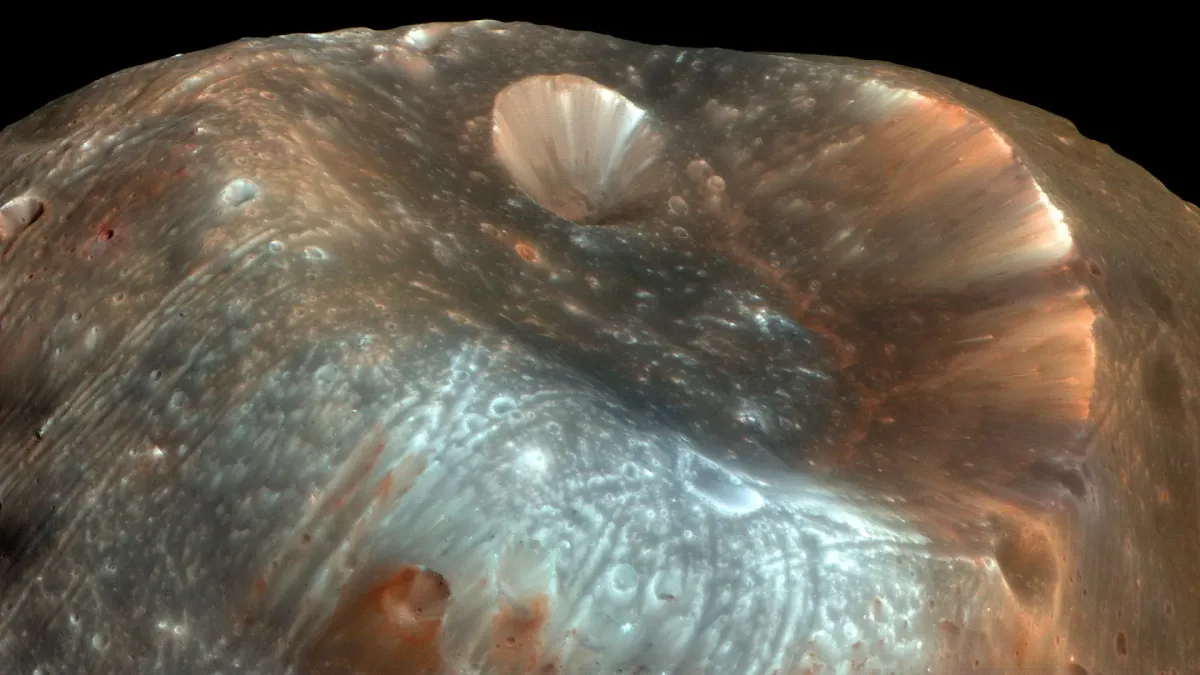
Scientists are digging into the secrets of Mars' innermost moon, Phobos, with a massive crater called Stickney potentially holding the key to its mysterious origin. For decades, experts have debated whether Phobos is a captured asteroid or a piece of debris from a colossal impact on Mars itself. Unraveling this puzzle hinges on understanding what Phobos looks like beneath its surface.
New research presented at the European Geosciences Union general assembly is focusing on geophysical measurements around Stickney Crater. This enormous impact scar, spanning 9 km (5.6 miles), could offer clues about the moon's history. If Phobos formed from Mars impact debris, the Stickney event might have occurred around 4.2 billion years ago. However, if it's a captured asteroid, the impact could be much younger, dating back about 2.6 billion years.
Current studies suggest Phobos has a porous interior, possibly containing water ice, and researchers are keen to map its gravity field in more detail. They're particularly interested in whether the Stickney impact left behind a denser region of material underneath. "The Stickney event is one of the most important episodes in Phobos' history, and learning more about it could help scientists determine where the moon came from," explained Benjamin Haser, a doctoral student involved in the research.
Phobos, with its small size (mean diameter 22.2 km / 13.8 miles) and rapid orbit, defies simple explanations. One leading theory suggests a giant object struck Mars, ejecting material that coalesced into the two Martian moons. The alternative is that Phobos and its sibling Deimos started as asteroids captured by Mars' gravity. Analyzing Phobos' gravitational field is crucial for understanding its internal mass distribution and, by extension, its formation.
The survival of Phobos after such a massive impact as the one that created Stickney Crater is another puzzle. Scientists theorize that the moon's unusually low and uniform density might have allowed it to absorb the impact, much like a sponge. This impact would have also generated intense heat, potentially melting and compressing the rock beneath the crater, possibly creating a detectable gravitational signature.
Several features of Phobos align with the captured asteroid theory, including its irregular shape, resembling what's known as a rubble pile asteroid. However, reconciling all its characteristics—shape, density, spectral properties, and orbit—into a single, coherent model remains challenging. Tiny variations in Phobos' movement and wobble, influenced by internal mass distribution, could be the key to unlocking these secrets.
Adding to its intrigue, Phobos is dynamically unique. Its orbit is drawing it ever closer to Mars, destined for either disruption or a fiery collision. This makes Phobos not just a relic of ancient events but also an actively evolving celestial body. Japan's upcoming Martian Moons Exploration (MMX) mission, slated for a late 2026 launch, aims to study Phobos up close and even return surface samples, offering the best chance yet to resolve its long-standing origin mystery.