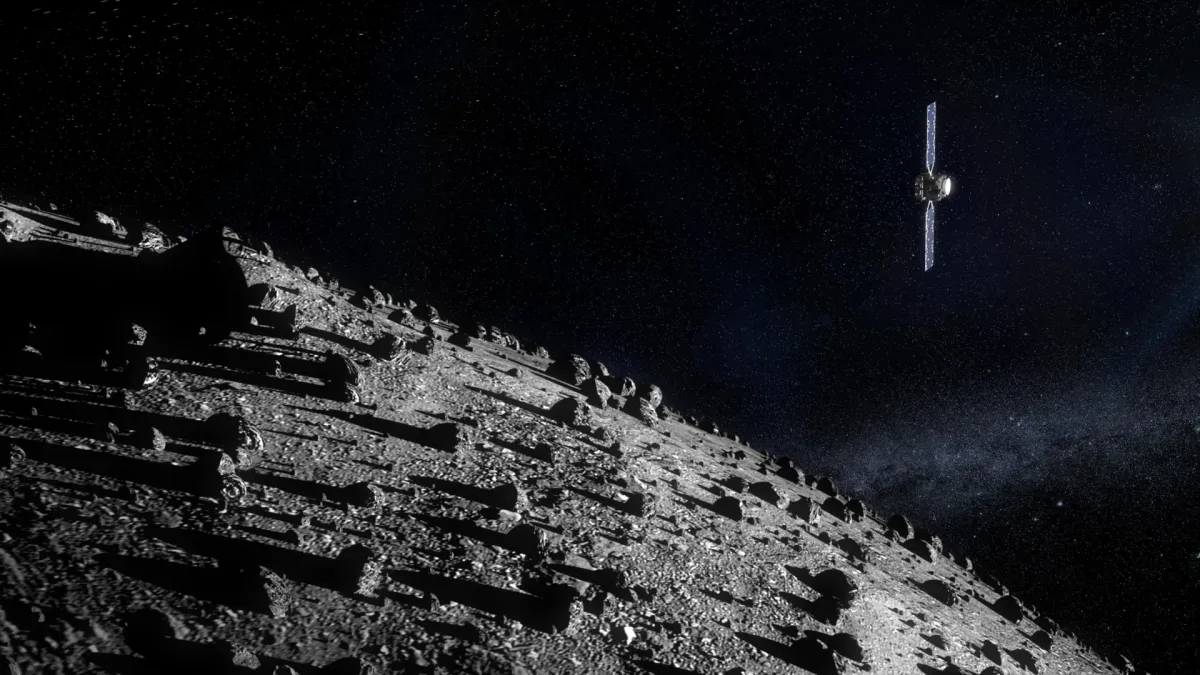
The European Space Agency's Hera spacecraft has officially spotted the asteroid pair Didymos and Dimorphos as distinct celestial bodies for the first time, marking a major milestone in its mission to study a historic asteroid collision.
The spacecraft captured the image on the evening of October 18, with the asteroids approximately 197 million kilometers from Earth. Using its Asteroid Framing Camera, Hera managed to distinguish Dimorphos from its larger parent asteroid, Didymos, from a distance of about 1,280 kilometers. Mission scientist Michael Kueppers noted that before this, the system appeared as a single point of light, but now, even though Dimorphos is only about one pixel in this initial shot, it's clearly separated.
This breakthrough image comes after Hera executed a series of thruster firings in early October, slowing its approach speed to just 20 meters per second relative to the asteroids. This careful maneuvering allows mission controllers to precisely manage the final stages of the approach. Despite appearing tiny in the image, Dimorphos measures about 151 meters across, comparable to the Great Pyramid of Giza, while Didymos is about 780 meters in diameter, slightly shorter than the Burj Khalifa.
Hera's arrival is set to provide scientists with a detailed look at the aftermath of NASA's DART mission, which deliberately collided with Dimorphos in September 2022. The impact significantly altered Dimorphos's orbit around Didymos, demonstrating the potential for kinetic impactors in planetary defense. However, the collision's outcome was more pronounced than predicted, leaving scientists eager to understand the asteroid's composition, internal structure, and mass, and whether DART left a crater or significantly altered its shape.
Over the coming months, Hera will conduct a thorough investigation of the "crash site," utilizing its scientific instruments and deploying two CubeSats for closer observation. The mission also anticipates potential landing operations. These efforts aim to enhance our understanding of how asteroids react to high-speed impacts, crucial for refining future asteroid deflection strategies. Interested individuals can follow Hera's journey through the interactive Hera Space Companion platform.