Physicists have officially confirmed the existence of a third type of magnetism, dubbed "altermagnetism," after nearly 90 years of classifying magnetic materials into just two categories: ferromagnets and antiferromagnets. This groundbreaking discovery, led by researchers at the SLAC National Accelerator Laboratory, reveals a new magnetic behavior that could revolutionize computing and electronics.
The new findings, published in the journal Science, present compelling experimental evidence for altermagnetism, a distinct magnetic phase that blends key characteristics of both traditional types. For years, scientists have observed phenomena that didn't quite fit the established ferromagnet-antiferromagnet model. "Researchers have been compiling evidence of a third type of magnetism that bridges the qualities of these two classes," explained lead author Daniel Jost. "We believe our results provide robust experimental confirmation that this third phase -- altermagnetism -- is real."
The team focused on manganese telluride (MnTe), a material previously thought to be an antiferromagnet. Their research uncovered direct evidence of chirality, a unique asymmetry in the material's magnetic structure that resembles a spiral staircase. This "handedness" is a key signature of altermagnetism, differentiating it from conventional antiferromagnets.
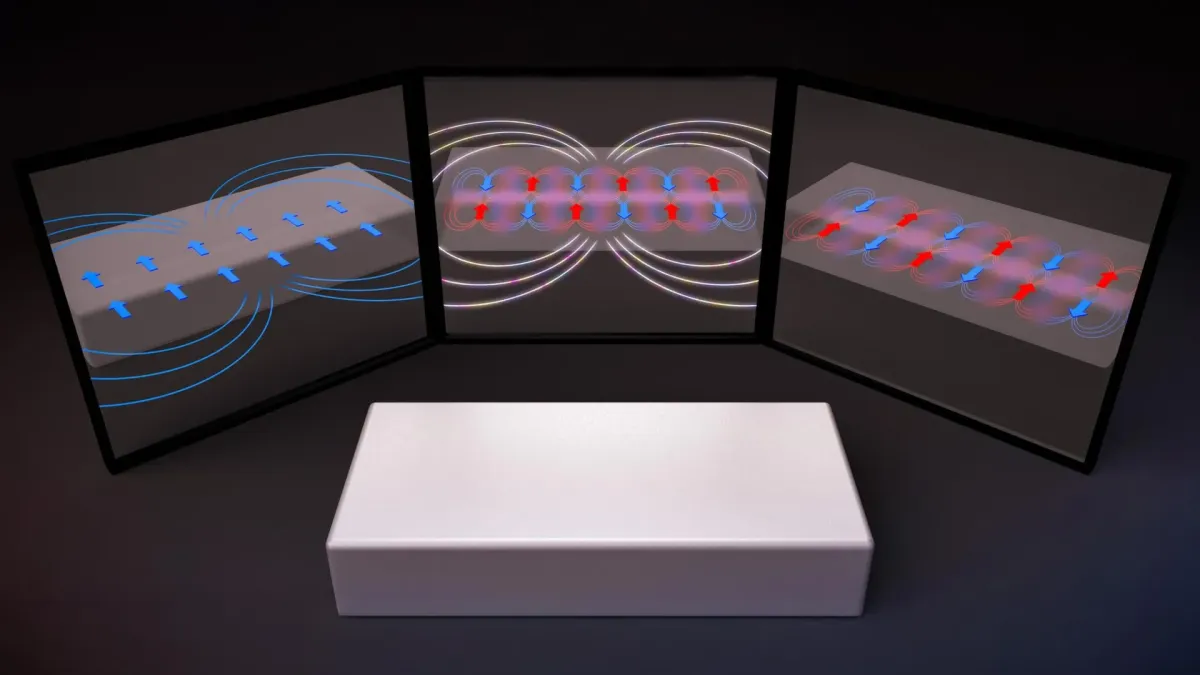
Magnetism, familiar from everyday items like refrigerator magnets, originates at the atomic level from electron spin. In ferromagnets, spins align in the same direction, creating a noticeable magnetic field. In antiferromagnets, neighboring spins point in opposite directions, canceling each other out and producing no overall magnetization. Altermagnets, however, combine alternating spins with a specific atomic arrangement that breaks symmetry, allowing them to possess properties once considered incompatible.
This discovery could significantly impact the field of spintronics, which aims to use electron spin, in addition to charge, for electronic devices. Altermagnets offer a potential sweet spot: they are magnetically stable like antiferromagnets but can generate useful spin currents, unlike them, and don't have the external field sensitivity of ferromagnets. This could lead to faster, more energy-efficient computing, advanced memory systems, and quantum devices.
The confirmation involved sophisticated experiments using circularly polarized X-rays at the European Synchrotron Radiation Facility. These X-rays revealed that manganese telluride scattered left-handed and right-handed polarized light differently, a clear indication of chirality and, therefore, altermagnetism. "This chiral signature gave us the solid experimental ground to say altermagnetism stands in a class of its own," Jost stated. Future research will focus on controlling these altermagnetic states to engineer practical technological applications.