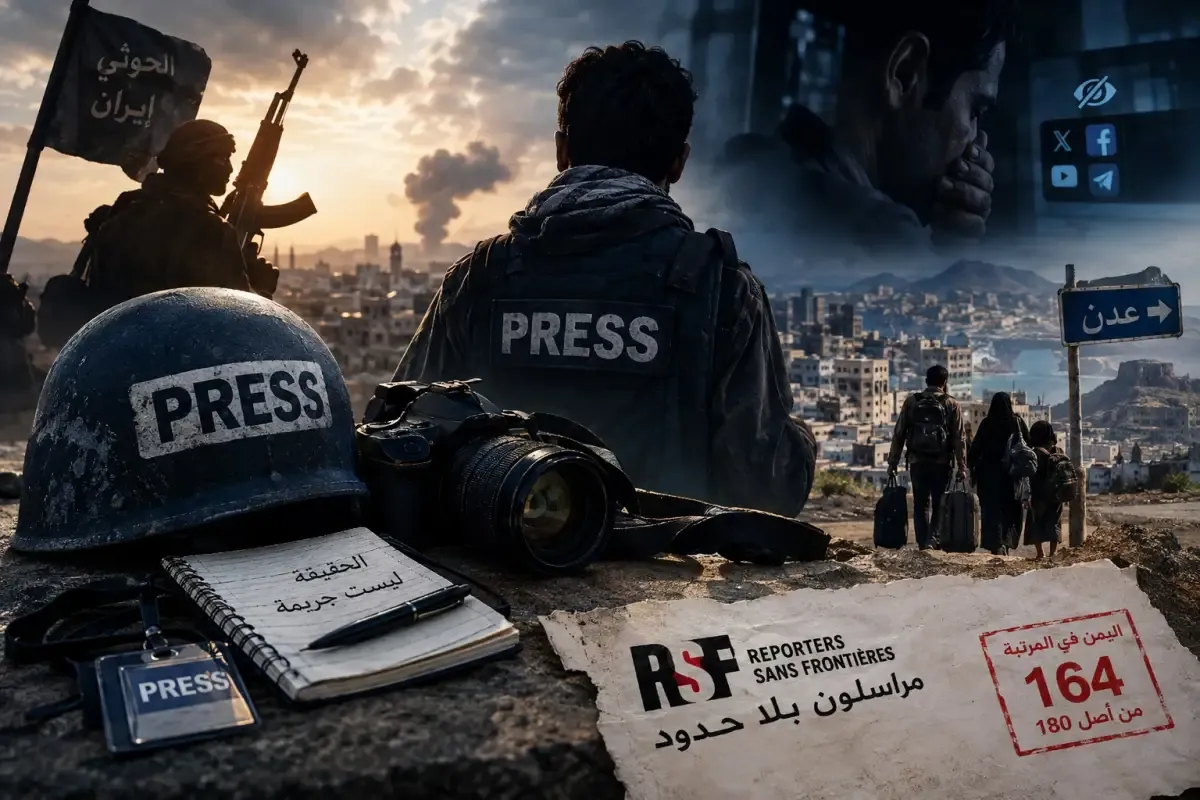
Reporters Without Borders has revealed the escalating plight of journalists in Yemen, citing increased threats, persecution, and displacement under Houthi control, while other regions also pose significant risks.
The organization's report, released following a Houthi offensive on the West Coast on September 9th, indicated that dozens of journalists have been forced to flee their homes. Yemen ranks a dire 164th out of 180 countries in the global press freedom index.
Testimonies gathered by Reporters Without Borders describe journalists escaping to Aden as Houthi forces advanced, while others lost their livelihoods and faced forced displacement. One employee of a local television channel recounted her husband's panicked return, urging her to pack essentials as Houthi tanks approached. Journalists expressed deep concern over their inability to access information in a dangerous environment dominated by rumors.
In Sana'a, fear of reprisal compels journalists to remain silent, even on social media. A journalist who fled the city reported increasing restrictions, noting that media professionals in northern Yemen are reportedly only permitted to comment on sports, illustrating the severe constraints on press freedom.
The risks extend beyond Houthi-controlled territories. The report highlights the case of sports journalist Abbad Al-Jaradi, who was held hostage by the group for 18 days in 2022 due to his work and later lived in exile in France. Additionally, the report notes that journalists in other parts of Yemen face growing security threats amidst the ongoing conflict and the presence of multiple armed factions.
Reporters Without Borders documented the death of Mohammed Ayedha, a correspondent for Al Arabiya and Al Hadath, on June 24th, from a car bomb explosion, with authorities later arresting two individuals linked to the Houthis on suspicion of involvement. A reporter from an Aden-based news agency shared their constant fear of encountering explosives under their vehicle, acknowledging that their work and sources make them potential targets.
According to Reporters Without Borders data, 40 journalists have been killed in Yemen since 2014, and three, Hassan Zaid, Walid Ali Ghalib, and Nabil Al-Sadaoui, remain missing after their abduction by the Houthis. The organization attributes the majority of journalist killings, abductions, and censorship to the Houthis, while also implicating government forces and other local entities in arrests and intimidation.
The report also addressed the difficulties faced by foreign journalists, stating that obtaining press visas for Yemen is nearly impossible. French journalist Kévin Muller, specializing in Yemeni affairs, was expelled in July 2026 for working without the required visa. Jonathan Dagher, Middle East Director at Reporters Without Borders, urged the Houthis to cease their intimidation of journalists and called on the government to provide protection and conducive conditions for their work.
The organization's findings reveal that Yemeni journalism is once again paying a heavy price for the conflict, not only through loss of life but also through displacement, enforced disappearances, detention, censorship, and a pervasive fear that silences many media professionals. This suppression of independent journalism exacerbates the information crisis in a country where rumors proliferate and access to truth diminishes.