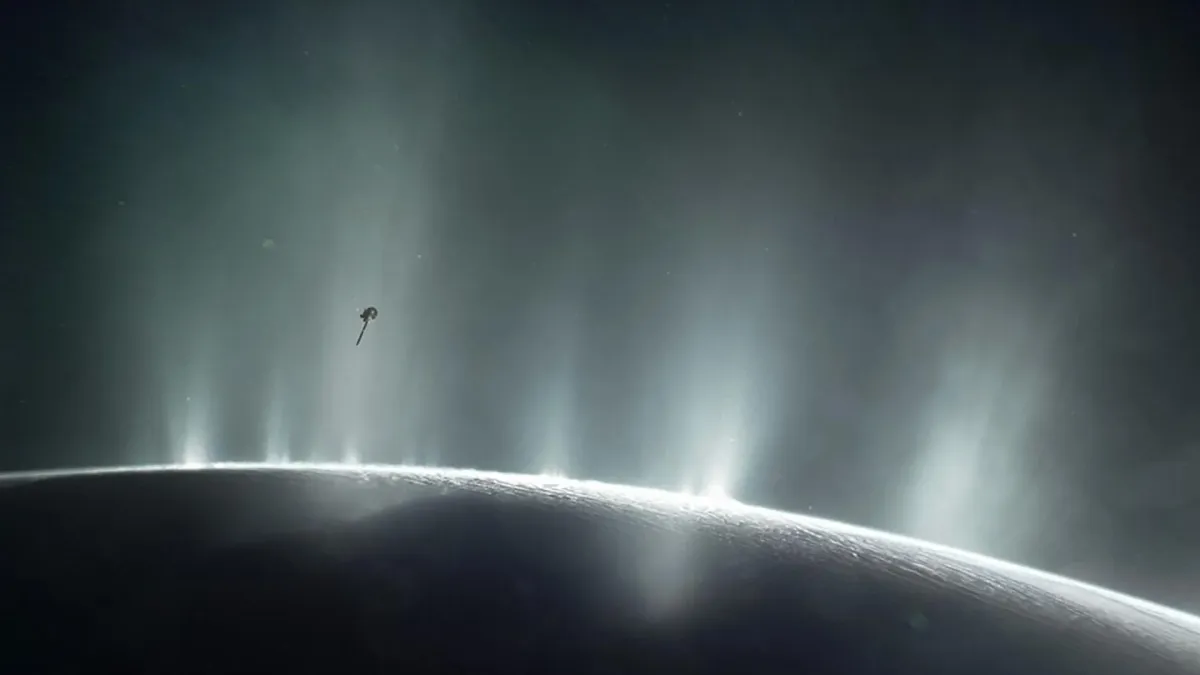
Scientists have discovered that the ice grains spewing from Saturn's moon Enceladus are much more chemically diverse than previously thought, suggesting a complex process occurring beneath the moon's icy crust.
While Enceladus is covered in ice, a global ocean lurks beneath. Fractures near the south pole blast water vapor and ice particles into space, offering a unique window into this alien ocean without needing to drill through miles of ice. An international team, including researchers from the Earth-Life Science Institute (ELSI), investigated how ocean water transforms into the tiny ice grains detected by the Cassini spacecraft.
Between 2004 and 2017, NASA's Cassini mission analyzed numerous ice particles in Saturn's E-ring, which is constantly fed by Enceladus' eruptions. A team led by Prof. Frank Postberg examined 961 salt-rich grain samples. Contrary to expectations that ocean water would yield similar salt mixtures, the grains showed dramatic variations. Some were loaded with sodium chloride, while others contained higher amounts of carbonates, phosphates, or potassium chloride. Notably, chloride and carbonate rarely coexisted in the same sodium-rich particle, posing a puzzle if they all originated from the same ocean.
To solve this, Professor Yasuhito Sekine and colleagues at ELSI recreated Enceladus' ocean droplets in the lab. They froze droplets with varying salt compositions and cooling rates, then analyzed how the elements separated upon solidification. Their experiments revealed that freezing speed is crucial. Slower freezing of larger droplets (around 200 micrometers) allowed different salts to segregate into distinct regions. Faster freezing resulted in more uniform mixing. "What surprised us was that the diversity seen by Cassini could emerge from droplets originating from essentially the same ocean water," Sekine stated. "Our experiments show that when relatively large ocean droplets freeze slowly, different salts can separate within them. If those frozen droplets are later broken apart, they can produce much smaller ice grains, each with very different chemical compositions."
These findings suggest a slower journey for Enceladus' ocean spray through the moon's icy crust than previously assumed. Instead of quickly freezing and heading to space, droplets might move gradually through underground vents, allowing time for salt separation. As these frozen droplets approach the surface, they could collide with vent walls at high speeds, breaking into smaller fragments. Each fragment, originating from a different segregated salt region within the larger, slowly frozen droplet, would then have a unique chemical signature. "The Cassini data showed us that these salt-rich grains are far more chemically diverse than an average ocean composition would suggest," Postberg explained. "Combining those observations with the freezing experiments gives us a physical explanation: Cassini may have sampled fragments of larger frozen ocean droplets, each preserving different components that became separated during their journey towards the surface."
This discovery is significant for future Enceladus missions. The natural separation and concentration of compounds within these ice grains could simplify the search for organic substances and signs of life. On Earth, significant effort is required to concentrate chemicals for analysis; Enceladus appears to do this naturally. Furthermore, slow freezing might trap liquid brine pockets, leading to highly concentrated salts and organics, a key factor for prebiotic chemistry. This ongoing process of freezing, concentration, and recycling could create conditions favorable for the emergence of life, providing crucial clues about the hidden ocean environment and helping future missions interpret their findings.