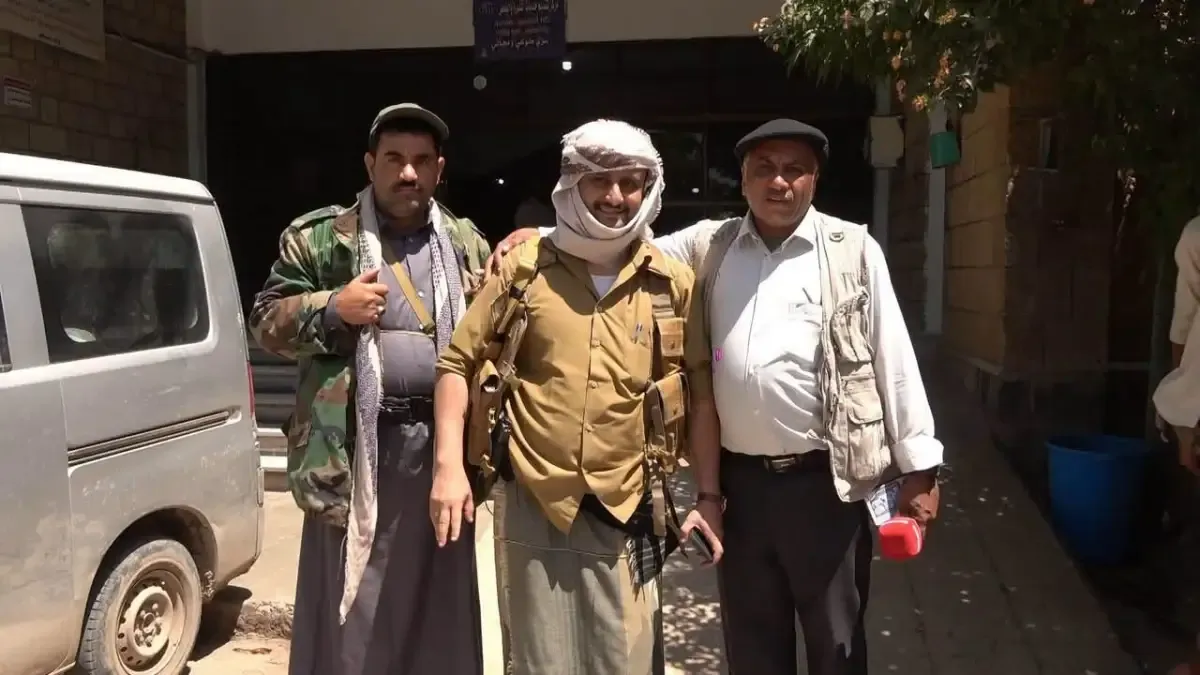
The reappearance of terrorist leader Amjad Khalid in the city of Al-Turbah, Taiz Governorate, alongside Houthi elements and leaders, following the group's seizure of the city, has reignited discussions about Khalid's associations during his years of residence in rural Taiz. These developments are accompanied by assertions of collusion between the Brotherhood and terrorist groups on one side, and the Iranian Houthi militia on the other, aimed at undermining the security and stability of the South and liberated governorates.
Local activists circulated a photograph on Wednesday showing Amjad Khalid in front of Khalifa Hospital in Al-Turbah, accompanied by Houthi elements and leaders. This marks his first widely shared appearance within the city after the Houthis took control. Local sources indicated his involvement in the offensive that led to the city's fall to the group.
Khalid's presence among the Houthis represents a significant development in his trajectory. For years, he has faced security and judicial accusations related to terrorist operations targeting figures in Aden. His residency in Al-Turbah consistently drew criticism regarding the entities providing him protection and operational freedom.
Previous reports from February 2025 indicated Khalid's arrest in the Tor Al-Baha region by forces affiliated with the Fourth Brigade. However, it was alleged that Brotherhood leader and commander of the Tor Al-Baha axis, Abu Bakr Al-Jubooli, concealed and facilitated his escape. Demands were made for his handover to security agencies in Lahj or the capital, Aden, as he is wanted in connection with terrorism cases. Later, Khalid reappeared in Al-Turbah under the protection of Brotherhood forces. Escalating government calls for his apprehension and presentation to justice prompted the Brotherhood forces to transfer him to Al-Houban, an area under Houthi control, where he reportedly received support.
The most controversial development, according to circulating accounts, is Khalid's transition from an environment ostensibly offering protection by the Brotherhood within areas aligned with government forces to openly appearing alongside the Houthis. Political and media voices interpret this as an indicator of converging interests among seemingly disparate groups and powers when confronting adversaries in the South and liberated regions.
Accusations have resurfaced linking Khalid to armed cells responsible for assassinations and bombings in Aden. These allegations have appeared in local reports and security investigations, though definitive criminal responsibility requires the backing of published judicial rulings and case files.
Further reports from June 2025 showed Khalid in a video after his home in Al-Turbah was raided. He accused forces loyal to Al-Jubooli of the intrusion and looting, and threatened to release recordings documenting his meetings with leaders of the Islah Party, revealing the extent of tension among parties associated with his presence in the region at the time.
Critics suggest Khalid's current appearance with the Houthis, after years in Al-Turbah, reinforces their view of "collusion" between parties that, while seemingly at odds, have shared objectives at various stages, such as countering southern forces and weakening liberated areas. This perspective posits that Khalid's presence in Al-Turbah, despite security accusations, allowed him to maintain a network of connections and movements before his subsequent relocation to Houthi-controlled territories and his current appearance with the forces that seized the city.
Journalist Nader Al-Sufi stated that Khalid's return to Al-Turbah in Houthi vehicles represents, in his view, a shift from operating against Aden and the South to targeting Al-Turbah itself. He accused Khalid of participating in operations against the popular resistance and local community leaders. Al-Sufi added that Khalid had remained in Al-Turbah for years under the protection of Abu Bakr Al-Jubooli, despite allegedly managing cells linked to assassinations in Aden. Khalid's current appearance with the Houthis raises questions about those who harbored him and facilitated his continued activities.
Activist Abu Muhtam Al-Dali described Khalid's presence with the Houthis as confirmation of warnings issued by southern forces years ago, noting that the individual once defended by some Taiz factions is now fighting alongside the Houthis in Al-Turbah. Political researcher Wadah Al-Hanbali went further, accusing Khalid and Al-Jubooli of orchestrating events that led to field collapses in Al-Turbah and other areas, suggesting the recent events resulted from prior coordination between the two.
These accusations, including claims of orders to withdraw or facilitate the handover of positions to the Houthis, remain accounts from political and media sources and have not been independently verified.
Journalist Ammar Ali Ahmed focused on the broader implications of Al-Turbah's fall, urging against using it as an occasion to revive animosity between the people of Taiz and the South. He argued that since 2015, Taiz has served as a crucial defense line for Aden and the South, while the South provides vital support and passage for liberated areas in Taiz. He cautioned that past political conflicts have enabled various forces to exploit this relationship and foster mutual hostility. Ahmed highlighted that harboring individuals accused of terrorism and operating against Aden, including Amjad Khalid, complicated relations between the two sides. He also warned against holding the entire population of Taiz responsible for the actions of specific groups or leaders.
This point is significant amid recent developments. The Houthi control of Al-Turbah not only alters the military map but also places new pressure on the vital artery connecting Taiz and liberated areas, reopening questions about the reasons for the military collapse and the beneficiaries.
Amjad Khalid's appearance with the Houthis poses several questions for the government, the Presidential Leadership Council, and security agencies: How did an individual facing serious security accusations remain for years in areas ostensibly under government control? Who provided him with protection or political and military cover? And how did he subsequently move to Houthi-controlled areas before appearing with the forces that seized Al-Turbah?
The danger lies not only in the image of one man alongside the Houthis but also in what it might reveal about the fragility of security and military control systems in liberated areas and the ability of armed groups to shift between spheres of influence and alter alliances based on conflict dynamics.
While some political and media voices accuse the Houthis, the Islah Party, and cells linked to Khalid of collusion against the South and Taiz, Brotherhood political entities aligned with the legitimacy have consistently rejected these accusations, promoting Khalid in their media as a national leader fighting for the nation and legitimacy.