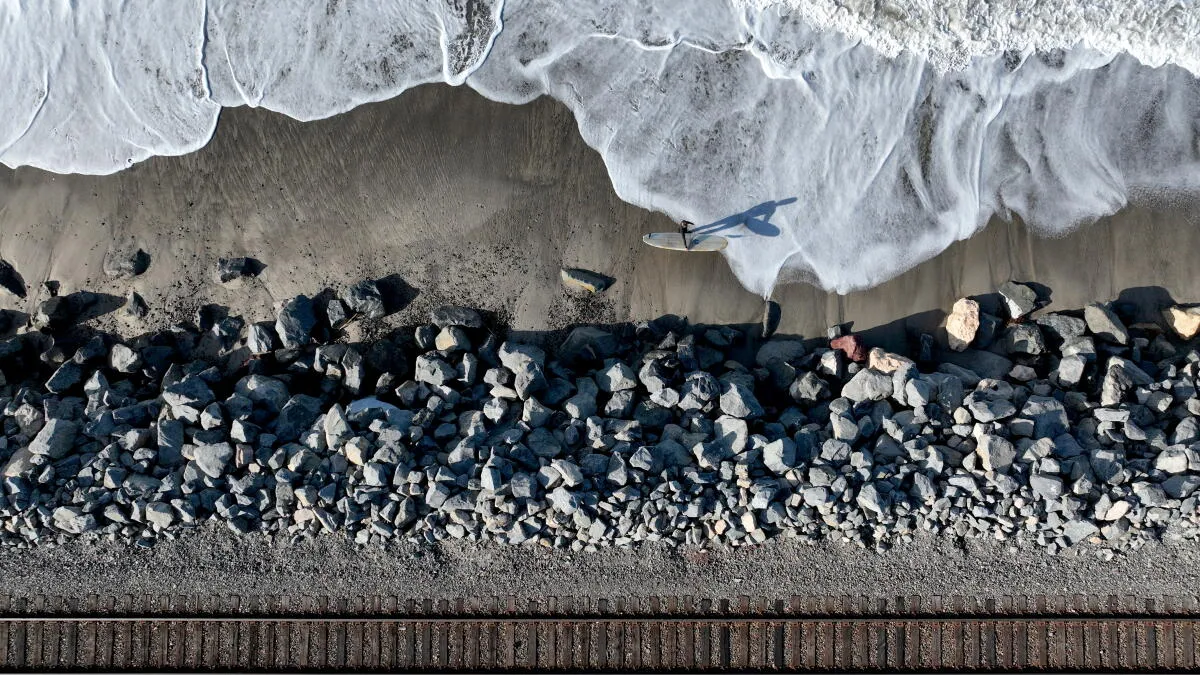
A significant sand replenishment project has been approved for San Clemente's beaches, aiming to fortify a critically eroding railway line while simultaneously restoring shrinking shorelines. The California Coastal Commission granted an extensive permit for the initiative, which railway officials hope will stabilize the vital rail corridor facing persistent threats from rising seas, powerful waves, and severe storms.
The permit allows for the placement of nearly 700,000 cubic yards of sand along sections of the coast where beaches have diminished or disappeared entirely. Orange County officials have described this as the most substantial sand replenishment effort in over six decades for this particular stretch of coastline. Orange County Supervisor Katrina Foley emphasized that this project represents a crucial first step toward addressing long-standing issues, acknowledging that previous efforts focused on "hardening" the coast with seawalls and rock piles may have inadvertently worsened erosion.
Foley advocated for the sand replenishment, stating, "Sand on the beaches is the solution... Wide sandy beaches serve as a necessary buffer to protect the rail line." With $300 million in state and federal funding secured for the protection of the four-mile coastal segment most affected, the sand replenishment, which will consume approximately one-third of these funds, could commence as early as January. The ten-year coastal development permit integrates emergency response measures and future plans by the Orange County Transportation Authority (OCTA) for rail line fortification, including the construction of a 1,200-foot seawall.
The permit also mandates mitigation efforts to protect the coast and maintain public access to beaches. It requires OCTA to manage and, where feasible, remove existing rock piles and "tiebacks" installed along bluffs inland of the railway. These structures were erected under emergency permits following recent storm damage that undermined the rail line. Furthermore, the permit obligates railway operators to monitor the effectiveness of the sand replenishment over five years, study the long-term viability of the rail line, and critically, investigate potential relocation sites for the vulnerable infrastructure.
The railway, operational since 1888, has always been susceptible to coastal conditions due to its location, a factor that also contributes to its scenic appeal for passengers. However, recent years have presented unprecedented challenges. The line experienced partial closures last month due to high tides, following a September closure caused by erosion and slope damage from a significant Pacific storm. During the summer, heavy waves and erosion led to several days of service disruption. OCTA reported that the railway has been cumulatively closed for approximately 12 months since 2021 due to erosion and bluff failures, with the Coastal Commission processing 15 track stabilization projects, including 10 under emergency permits, during the same period.
Despite the permit being described as a collaborative effort by Coastal Commission staff and OCTA, numerous environmental advocates, surfers, tribal leaders, and beachgoers voiced concerns that the agreement does not adequately protect the coastline. A coalition including the Surfrider Foundation and Orange County Coastkeeper argued in a letter that OCTA has failed to plan for foreseeable hazards, violated permits, and used rocks that have diminished beaches without reliably safeguarding the railroad. They urged the commission to require OCTA to maintain a 50-foot sandy beach seaward of the railway post-replenishment.