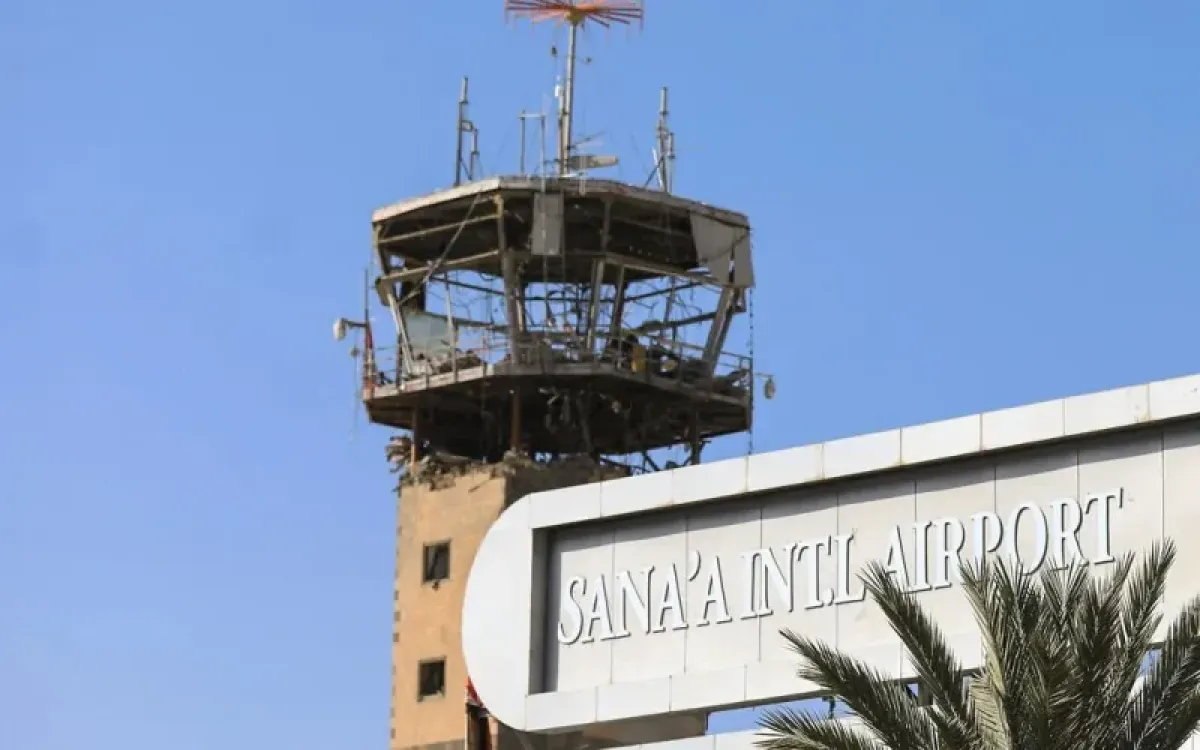
Sana'a International Airport, controlled by Houthi militias, has witnessed significant air traffic in recent days, with multiple aircraft of varying sizes arriving and departing within close intervals, sparking widespread questions about the nature of these flights, their operators, and their cargo, particularly given existing air traffic restrictions.
Dr. Abdulqader Al-Kharrz, a Yemeni academic and researcher, reported that a large cargo plane landed at Sana'a Airport on Thursday, August 20, 2026, at 09:10 AM, noting this flight was part of increased air activity observed at the airport recently. He provided video footage of the aircraft's arrival.
This latest arrival follows a day where, according to Al-Kharrz's observations, five aircraft were present at Sana'a Airport within a short period. The activity included a mix of large, medium, and small aircraft. One large plane arrived at 09:08 AM and departed less than an hour later at 09:56 AM. A medium-sized aircraft arrived at 11:15 AM and left at 12:36 PM, while a small plane arrived at 11:30 AM and departed approximately an hour later. A fourth large aircraft arrived at 12:58 PM and departed at 03:14 PM, with a fifth small plane still at the airport at the time of the information's release.
This timeline indicates relatively unusual activity, especially as it occurs amidst ongoing reports of restrictions on air traffic at Sana'a Airport. The situation raises questions beyond the sheer number of flights, focusing on the beneficiaries and objectives of this traffic. While arrival and departure times are noted, the available data does not definitively identify all aircraft, their affiliations, the nature of their cargo, or the actual purpose of these flights.
Al-Kharrz's disclosures suggest that one of the aircraft carried an Omani official, while another reportedly transported an Iranian official upon arrival. Furthermore, information indicated that one departing flight carried the remains of deceased Iranians and wounded individuals, along with injured Houthi militia members. If confirmed, these details would elevate the recent air traffic beyond routine civilian activity, particularly given the known relationship between the Houthi militia and Iran, and persistent accusations of Iranian support for the group. However, the exact nature of these flights and their payloads require independent official confirmation, as observational data alone is insufficient to ascertain specific details.
The unusual aspect is not merely the presence of multiple aircraft but the lack of sufficient official information explaining the increased air movement. While millions of Yemenis suffer from travel restrictions and air mobility challenges, and commercial air traffic to and from Sana'a remains limited compared to pre-war levels, private flights, including cargo planes, occasionally appear without clear details about their routes or missions being disclosed to the public. This fuels speculation regarding who grants permission for these flights, the nature of the coordination involved, and whether they are exclusively for civilian or humanitarian purposes, or if other objectives are involved. The lack of transparency from relevant authorities regarding flights of public interest exacerbates these concerns, especially for Yemeni travelers facing significant difficulties reaching their destinations while certain private flights seem to operate under different conditions.
Political analyst Nayef Al-Qaness questioned the continued hardship faced by Yemenis alongside the near-daily arrivals at Sana'a Airport, inquiring about the source of these planes, their cargo, and the authority permitting their entry. Al-Qaness criticized the ongoing lack of transparency in air traffic, arguing that flights operating under existing airport restrictions raise questions about the arrangements that allow some to land while ordinary citizens remain the most affected by travel limitations. He also revisited the Jordanian initiative, which was intended to alleviate Yemeni suffering and provide humanitarian relief, and questioned the stance of the legitimate government's air force regarding flights arriving at Sana'a Airport. Al-Qaness further criticized persistent Houthi promises of lifting blockades and disbursing salaries amidst ongoing economic and living condition deterioration, suggesting that behind-the-scenes dealings might involve agreements to maintain the status quo for the benefit of conflict parties, without tangible improvements for the suffering population.