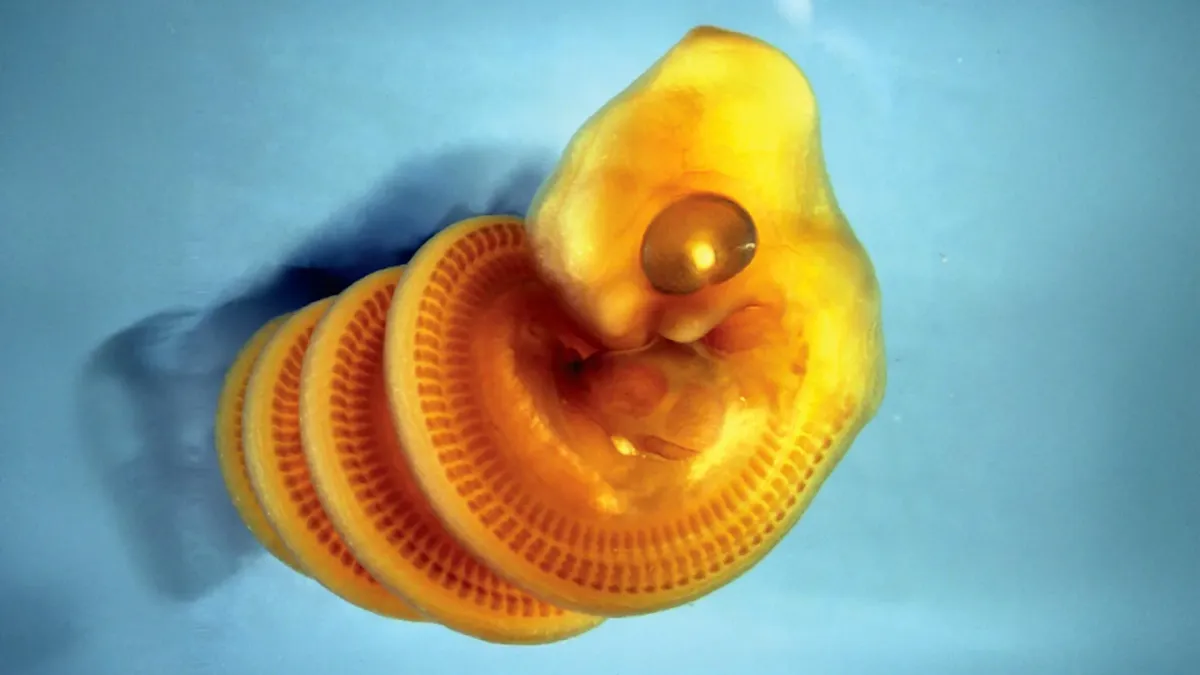
Scientists have likely cracked the code behind why snake embryos curl into tight spirals before hatching: their super-long bodies and a tethering gut. This coiling seems to be a clever way for developing snakes to accommodate their lengthy forms, a feature that sets them apart from all other vertebrates.
The research, published in Current Biology, points to the embryo's rapidly lengthening body and a gut that acts like a leash as the key players. As the body stretches, this constraint causes it to buckle and twist into a distinct right-handed coil. "It's similar to adjusting a strap, where the longer, buckling part of the loop starts to twist," explained senior author Dr. Tetsuto Miyashita, an evolutionary biologist at the Canadian Museum of Nature.
This discovery adds snake embryos to a growing list of naturally occurring spiral structures that continue to intrigue scientists. "There's an inherent mystery to spirals, and we're just beginning to grasp how these shapes form in animals, from our own winding intestines and snail shells to these beautiful coiled snake embryos," shared lead author Alexandra Weber, now a graduate student at the University of British Columbia.
The study itself has an interesting origin story. During the 2020 COVID lockdown, Dr. Miyashita, working from home, sought a research question his students could tackle remotely. He recalled a fascination with asymmetries in animal forms and wondered about the coiling direction of snake embryos. This question became the cornerstone of the project.
To investigate, Miyashita tasked Weber and two undergraduate students with scouring published research and museum databases for photos of developing snakes. They amassed images of over 900 embryos from 39 snake and other limbless squamate species, a robust sample size. A clear pattern emerged: in the early weeks after laying, embryos consistently coiled dextrally, or to the right, when viewed from head to tail. Since the embryos lacked muscles to actively coil, the researchers suspected a physical developmental factor was at play.
A breakthrough came from Dr. Raul Diaz at California State University Los Angeles, who used CT scans to examine the embryos. The scans revealed an unexpected internal structure: a "pillar of gut" stretching through the coiling body, detached from the rest of the body and surrounded by yolk-sac blood vessels. This observation provided the missing mechanism. Snake embryos grow their bodies incredibly fast, but their guts don't keep pace. This growth mismatch creates a mechanical constraint, forcing the body into a spiral. The gut's position, often to the left of the embryo, directs this coiling to the right.
Interestingly, this right-handed coiling isn't permanent. As embryos grow, the yolk shrinks, granting them more space, and their muscles develop, allowing active movement. Some embryos maintain their right-handed coil, while others shift to the left. By the time they are close to hatching, about half are coiled right and half left, suggesting the initial coiling direction is dictated by anatomy and physics rather than deliberate muscle action.
For Dr. Miyashita, this finding highlights how a simple question can lead to significant biological insights. While genetics research has been key to understanding snake evolution, this study shows the power of basic observation. "We uncovered a snake's secret with a startlingly simple approach," he noted.
The researchers believe this model could be applied to understanding other spiral structures in nature. "We are now opening the possibility to develop this model further to explain other spiral forms in nature," Miyashita added. Weber concluded, "This all started out with a curiosity to see if snakes are 'handed.' It was exciting to follow it to deep insights about their evolution." The collaborative effort included scientists and students from institutions across North America and Finland.